
Disclosure : This post may contain affiliate links or paid partnerships. I may earn compensation if you click a link or make a purchase, at no additional cost to you. See my disclosure for more info.
Here’s the thing nobody tells you about a beautifully styled side table.
Most of what makes it look great is already in your home. Hiding in a bookshelf, sitting in a drawer, living on a different surface where it’s been ignored for years.
You don’t need to go shopping. You don’t need a budget. You need to look at what you already have — and start placing it with intention instead of accident.
These 27 ideas are built around that premise. Each one can be executed tonight, using objects that almost certainly already exist somewhere in your home.
The side table you want is probably two rooms away. Let’s go find it.
Start With What You Already Have: The Foundation
1. Clear everything off. Use what you already own to style it fresh.
The reset is free. And it’s mandatory.
Remove everything currently on your side table — everything — and set it aside. You’re not throwing anything away. You’re creating a blank surface so that what goes back can be chosen rather than accumulated. This single step costs nothing and makes everything else on this list work better.
2. Group three objects from your home at different heights.
Walk through your home right now. Find three objects: something tall, something medium, something small.
A lamp from the bedroom. A small plant from the kitchen windowsill. A candle from the bathroom shelf. Three objects you already own, grouped together at varied heights. That’s a well-composed side table arrangement. Nothing purchased. Everything intentional.
3. Create height variation using books you already own.
Look at your bookshelf. Find two or three books you genuinely like the look of.
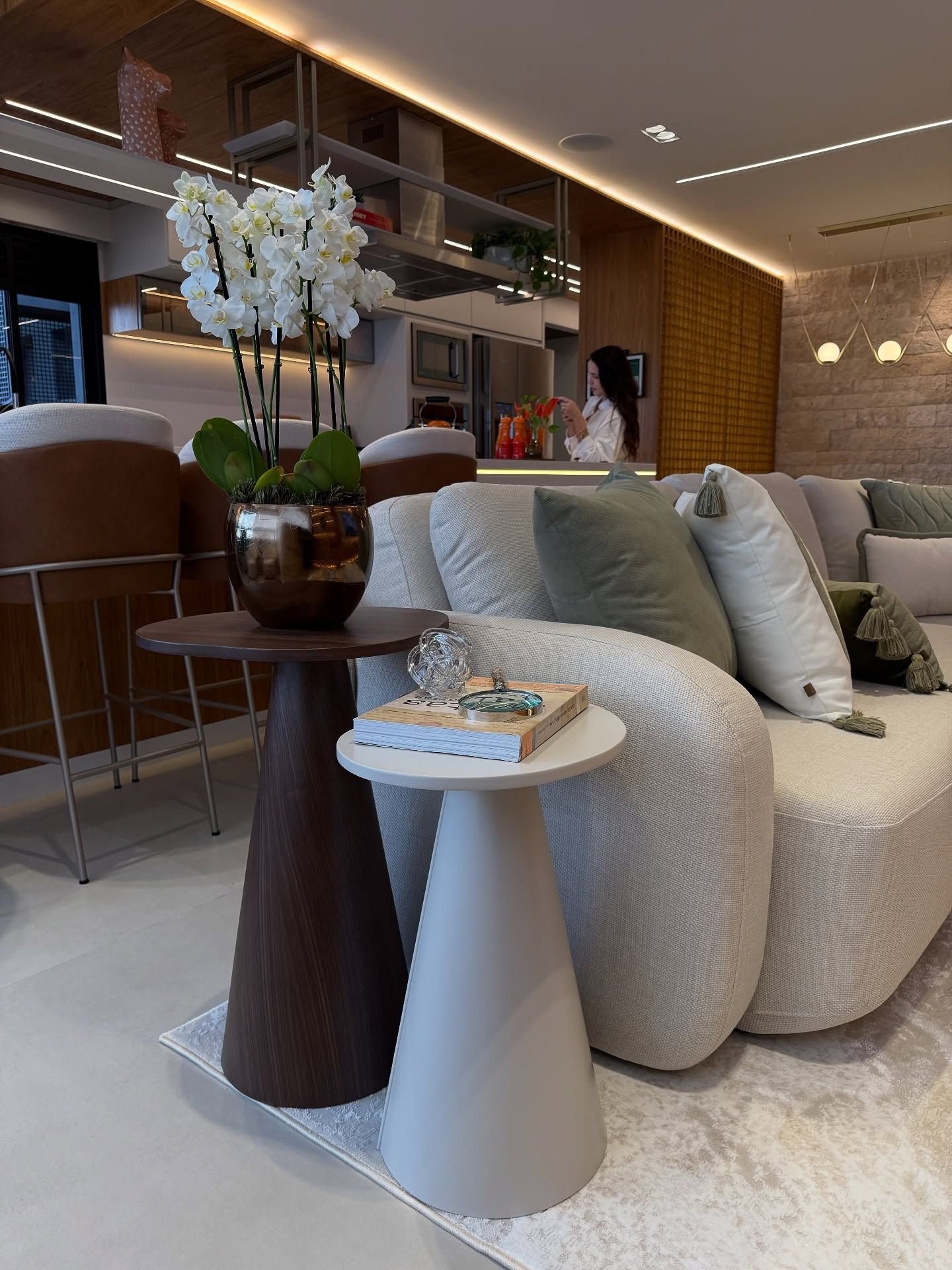
Stack them on your side table and rest something small on top. You’ve just created height variation and visual interest using objects that have been in your home for years, possibly doing nothing. This trick is entirely free and consistently effective.
4. Identify the most beautiful object you own and make it the centerpiece.
Go look at what you already have. Really look.
There is almost certainly a sculptural vase, a bold lamp, or even a striking clock somewhere in your home that is genuinely beautiful but not currently getting its moment. Give it one. Place it on your side table as the primary piece and build everything else around it. Your best object deserves center stage.
The Lamp You Already Own Can Do More
5. Move an existing lamp from another room to your side table.
You probably have a warm-toned table lamp somewhere in your home that is doing less than it should.
In the bedroom. In a corner. In a room that doesn’t need it as much as your living room side table does. Move it tonight. The shift from overhead lighting to a well-placed table lamp is the single most impactful change available to your living room, and you may already own everything you need to make it happen.
6. If cords bother you, hide them with what you have now.
Before buying a cordless LED lamp, try managing the existing cord with a book or a small basket already in your home.
Position the lamp so the cord runs behind the table rather than across it. Tuck it out of sight with a woven object from elsewhere in the room. You may find the cord situation is already solvable without spending anything — and that discovery postpones or eliminates the purchase entirely.
7. Find a candle somewhere in your home and bring it to the side table.
Check every drawer, every bathroom shelf, every storage box. There is probably at least one candle waiting to be used.
Place it beside your lamp tonight. Light it. The layered warmth of lamp and candle together transforms the atmosphere of any room. This costs absolutely nothing if the candle already exists. And it almost certainly does.
Your Bookshelf Is Already a Styling Resource
8. Pull two or three of your own books for a free height riser.
Coffee table books, paperbacks, hardcovers — any will work.
Choose ones whose covers you like, stack them neatly, and place a small object on top. You’ve created height, visual texture, and a decorative display using books you already own. The arrangement works in any room with any style. It costs nothing and takes two minutes.
9. Choose books whose spine colors already work with your room.
Scan your shelves for spines that match your room’s existing color palette.
You likely already own books in colors that work together — you just haven’t used them this way before. Pull the ones that complement your wall color, your sofa, your rug. Or face them backward for an instant neutral look. No new books required.
10. Find any flat tray or dish large enough to contain your display.
Before buying a small tray, check what you already have.
A wooden serving board from the kitchen. A large flat plate that doesn’t get used. A shallow basket from a different room. Any flat, contained surface can function as a tray — gathering your objects into a unified display and making the arrangement look intentional rather than scattered. The purchase can always come later.
Your Home Is Full of Organic Material
11. Move an existing plant to your side table right now.
Look around your home. Where are your plants currently living?
Are they in better positions than your side table? Often, the answer is no. A small potted plant that has been sitting on a windowsill or a shelf for months might be exactly what your side table needs. Move it there tonight. If it’s too large, take a cutting in a small vessel. A bud vase with a single stem works as well as anything else.
12. Collect dried botanicals from your garden or neighborhood for free.
Dried eucalyptus doesn’t have to come from a store.
Dried seed heads, grasses, branches with interesting forms — these are freely available in most gardens and neighborhoods in autumn and winter. Collected and placed in a simple vase, they produce exactly the kind of organic texture that pampas grass provides commercially, at zero cost. Look around outside and see what the current season has to offer.
13. Find driftwood or a beautiful branch on your next walk outside.
This is the most genuinely free styling move on the entire list.
On your next walk — in a park, along a beach, through a neighborhood — look for a piece of smooth driftwood or a branch with an interesting sculptural form. Bring it home. Place it on your side table. It adds raw organic texture and genuine natural character that costs nothing and was found rather than purchased.
What’s Already in Your Home Has Material Variety
14. Mix materials by drawing from different rooms in your home.
Your home almost certainly contains a range of materials — ceramic, glass, wood, metal, woven.
Pull a ceramic vase from one room and a brass candle holder from another. Bring a glass object from the kitchen and a woven basket from a different shelf. The contrast between these materials — already owned, already in your home — creates the visual richness that makes a side table look styled rather than assembled.
15. Find a woven or textile element already in your home.
A woven coaster from a coaster set you rarely use. A linen napkin from the kitchen drawer. A small piece of fabric from a craft box.
Any of these, folded and placed under a vase or lamp, adds the soft, warm counterpoint that hard surfaces need. You own something that will do this job. It probably hasn’t been pressed into service yet. Tonight is its moment.
16. Identify one metallic object already in your home and give it a spot.
Look through your home for a single item with a metallic finish.
A brass picture frame from a different wall. A brass candleholder that has been in a drawer. A copper dish from a different shelf. One metallic element on your side table catches light and elevates the whole arrangement. You almost certainly already own something that can serve this purpose.
The Stories Your Objects Already Tell
17. Find the most personally meaningful small object in your home.
You don’t need to buy meaning. You already own it.
Walk through your home and look for an object with a genuine story. The stone from somewhere important. The small piece of pottery bought at a market years ago. The heirloom that has been sitting in a box. That one object, placed on your side table, transforms it from a styling exercise into a genuine expression of who you are.
18. Take a framed photo from another room and lean it against the wall.
You own framed photographs. They are probably on walls throughout your home.
Take one down — a 4×6 or 5×7 framed print from a less prominent wall — and lean it informally against the wall behind your side table. No installation. No new purchase. Just a different placement of something you already own that creates a layered, gallery-like effect with zero effort or cost.
19. Use a beautiful small bowl or dish you already own as an everyday catch-all.
Check your kitchen and dining cabinets. Look in any storage boxes that hold miscellaneous objects.
There is very likely a beautiful small dish somewhere in your home that isn’t being used. A small ceramic bowl. A marble trinket dish. Any attractive small vessel. Give it a place on your side table for keys, rings, and the other everyday items that always land there anyway. Found, not purchased. Useful and decorative simultaneously.
Using Space and Scale With What You Have
20. Leave empty space — it costs nothing and improves everything.
This is the only styling tip on this list that requires no objects at all.
Leave at least a third of your side table surface completely bare. Do not fill it. The empty space is doing active work — it makes every object on the table look more deliberate and more important. Negative space is the free design element that most people waste by filling it with things that don’t belong.
21. Scale your chosen objects to match your actual table.
From the objects you’ve gathered from around your home, choose ones that feel proportionally right for your table.
Too large: it overwhelms. Too small: it disappears. Hold each object up to the table and ask whether it looks comfortable there. Trust your instinct — it is usually right about proportion. You don’t need design training for this. You need honest eyes and a willingness to put some things back.
22. Keep your arrangement’s height within 1.5 times your lamp shade.
Measure nothing. Just look.
Step back from your arrangement and ask: does anything reach uncomfortably high compared to the lamp? Does anything feel like it might topple? If yes, swap it for something slightly lower. This intuitive version of the 1.5x rule takes five seconds and prevents arrangements from looking precarious or top-heavy.
Free and Nearly Free Finishing Touches
23. Find a candle you already own for the scent element.
Check every room in your home for an unused or partially-used scented candle.
Bathroom shelves. Bedroom drawers. Storage boxes from gift occasions. Most homes contain at least one forgotten scented candle waiting for its purpose. Bring it to your side table. Light it. The olfactory layer it adds to your arrangement — and your living room — is immediate and powerful. You almost certainly own this already.
24. Use the current season to guide your one free seasonal swap.
Look outside. What season is it? What does it look like right now?
Find one object in your home or your immediate outdoor environment that speaks to the current season — a branch, a dried seed head, a shell from last summer still sitting on a shelf — and add it to your side table as the seasonal element. Free, found, and perfectly timed to where you are in the year.
25. Use any flat object as a pedestal to elevate one key piece.
Before purchasing a marble coaster for this purpose, see what you already own.
A thick hardcover book. A flat stone. A square of tile from a renovation project. Any flat object an inch or two high can elevate a candle or small vase and create the visual hierarchy that makes one piece read as more important. Free, found, and just as effective as something purchased.
26. Spend five minutes each month editing rather than adding.
The monthly edit is the free maintenance practice that keeps everything looking good.
Once a month, look at your table honestly. What has stopped earning its place? Remove it. What new object from elsewhere in your home might deserve a turn? Rotate it in. This five-minute habit — always subtractive before it is additive — keeps the arrangement alive without costing a penny.
27. Step back and assess from across the room. Adjust freely.
The final check is always free.
Walk to the other side of your living room and look at the table from where your guests actually experience it. Does it look good from there? Does it make the corner feel complete? If something is off, move one object. Remove one piece. Adjust a height. The assessment costs nothing. The willingness to respond to what you see is all that’s required.
Tonight. With What You Have. Right Now.
You have everything you need.
A lamp somewhere in your home. Books on a shelf. A candle in a drawer. A plant on a windowsill. A meaningful small object in a box or on a different surface. A beautiful dish in a cabinet.
Choose three ideas from this list and go find the objects that make them happen. Don’t buy anything yet. Don’t plan a shopping trip. Just look at what you already own with new eyes and ask: where should this actually be?
The side table you want is already in your home. It’s just been assembled in the wrong places.
Tonight, you fix that.
And when someone sits in your living room and notices something has changed — something feels more intentional, more considered, more like you — you’ll know that everything they’re responding to was already yours. You just finally put it in the right place.