
Disclosure : This post may contain affiliate links or paid partnerships. I may earn compensation if you click a link or make a purchase, at no additional cost to you. See my disclosure for more info.
Less floor space doesn’t have to mean less quality.
The rooms that prove this point most convincingly tend to share a quality that has nothing to do with square footage: every element in them was chosen carefully. Nothing is there by default.
In a small room built around bunk beds, achieving that quality is entirely possible. It requires thinking clearly about what the room needs and being deliberate about how each need gets met.
Here are 17 specific interventions — chosen for rooms where space is genuinely limited and standards are genuinely high.
Vertical Space as Your Primary Resource
Small rooms have less floor, but they have the same ceiling height as large ones.
Bunk beds are the most direct expression of vertical thinking — sleeping surfaces stacked to free the floor below. But vertical thinking should extend beyond the beds themselves to the lighting, storage, and personal elements of the room.
The bunk bed is not an obstacle to vertical living. It is its primary tool.
17 Interventions for the Deliberate Small Room
1. A Sconce for Each Bunk Level
Mount a small LED wall sconce at a comfortable reading height beside each bunk.
Individual lighting is a prerequisite for individual comfort in shared sleeping spaces. It also eliminates the visual coldness of overhead-only illumination, replacing it with the kind of layered light that makes a room feel considered.
2. Simple Linen Curtains Across Each Bunk
A slim tension rod and a panel of natural linen across the face of each bunk.
Linen has the right properties for this application: it diffuses light, adds natural texture, and communicates a quality that heavier synthetics don’t. More practically, it creates the privacy and enclosure that makes each bunk a place you genuinely want to be.
3. A Single, Strong Wall Color
Choose one saturated color and apply it to the wall the bunk beds occupy.
Deep sage. Warm terracotta. Off-black with a warm undertone. Something that communicates intention.
The bunk frame in front of it takes on an entirely different quality — deliberately placed, visually grounded. The room immediately stops feeling accidental.
4. Stairs With Storage in Every Step
Stair units with integrated drawers are among the highest-efficiency storage solutions available for small rooms.
They occupy the footprint of the stair access — which is required regardless — and return multiple full-size drawers of hidden storage. No additional furniture. No additional floor area. Clean, closed, contained.
5. A Restrained Bedding Palette Across Both Levels
Select bedding in a palette that holds both bunks together visually.
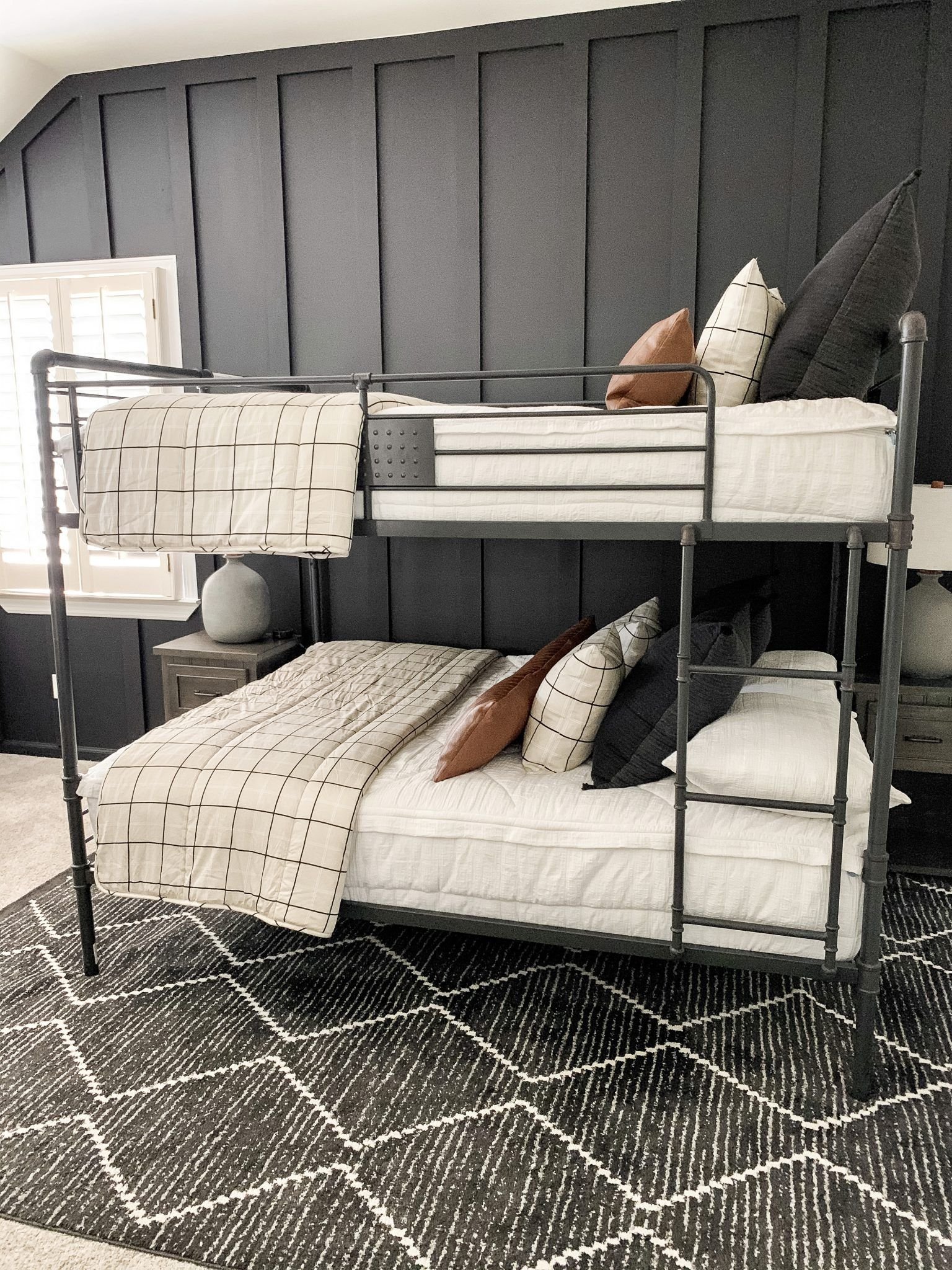
Restraint is the operative principle. Two or three tones. Natural materials where possible. The goal is a bunk bed that reads as a single composed element, not two separately-made beds that happen to share a frame.
6. Under-Bed Storage or Trundle
A low-profile trundle or flat storage drawer slides beneath the lower bunk and activates otherwise unused floor area.
In a minimally furnished room, this kind of invisible storage — closed, contained, not visually present — is exactly the right kind. It solves the storage problem without creating an aesthetic one.
7. Simple Personalization Above Each Bunk
A single initial or name element mounted above each bunk.
Minimalist rooms can still be personal. The question is how to signal belonging without accumulating objects. A clean typographic name above each bunk does this efficiently: it marks territory, it personalizes the space, and it requires nothing else around it to read clearly.
8. One Shelf per Bunk, Well-Placed
A single well-proportioned floating shelf within reach of each bunk.
Not a shelf system. Not multiple shelves. One, sized correctly, positioned exactly. A glass of water. A current book. One small personal item. Everything else goes elsewhere.
The discipline of one shelf per bunk is what keeps the room from becoming a ledge-based accumulation system.
9. L-Configuration When the Room Layout Allows
An L-shaped configuration suits a room where vertical stacking would create an oppressive tunnel effect.
The perpendicular lower bunk opens a naturally sheltered floor zone that can hold a desk or storage unit without occupying the room’s primary open area. The visual result is also more dynamic — a layout with complexity rather than pure vertical repetition.
10. A Single Wallpaper Pattern Inside Each Bunk
Apply a carefully chosen removable wallpaper to the inner walls of each bunk.
In a minimally decorated room, the bunk interiors are the appropriate place to introduce pattern and personality. Because they’re physically contained within the frame, they don’t compete with the rest of the room. They inhabit their own quiet world.
11. Warm-Toned LED Strip Under the Upper Frame
A strip of warm-white LED tape on the underside of the top bunk.
This is ambient lighting at its most useful: gentle enough to be restful, bright enough to be functional, architecturally integrated rather than appliance-like. It also makes the lower bunk feel inhabited and considered in a way that no floor lamp or ceiling light achieves from that angle.
12. A Slide for Families With Young Children
If the room serves children of slide-appropriate age, a slide attachment on the upper bunk converts a functional object into an experiential one.
It requires specific floor clearance. Most current models are removable. The argument for inclusion in a room designed around children’s joy is straightforward.
13. A Desk Below the Loft Level
A loft-height bunk enables a full-height workspace below it.
In a small room where a desk would otherwise require sacrificing sleeping or storage space, this configuration recovers the lost square footage by building vertically. The zone below the loft becomes a functional room within the room.
Add a good task light and a pin board to complete the setup.
14. A Woven Basket Hung From the Rail
One natural-fiber hanging basket on the side rail of the upper bunk.
It performs the same function as a bedside drawer — contains the small items that accumulate near any sleeping surface — without requiring a surface. It also introduces organic texture into a room that might otherwise read as too architectural.
15. Material Contrast Between Frame Levels
A deliberate difference in material or finish between the upper and lower bunk — raw oak above, painted below, or black metal above, white-painted wood below — adds visual depth without pattern or color complexity.
This kind of material restraint — two tones, two textures, one shared hardware element — is a design approach that scales well into minimalist aesthetics.
16. A Canopy That Defines the Upper Level
A sheer, natural-toned canopy hung above the top bunk.
In a restrained room, this is the kind of element that earns its place by doing multiple things simultaneously: it defines the upper sleeping zone, introduces soft vertical movement, and makes the top bunk feel enclosed without feeling confined.
17. A Two or Three Color Palette Held With Consistency
The palette constraint — two or three colors, applied everywhere, without exception — is what produces rooms that read as designed rather than assembled.
In minimalist interiors, the palette does most of the emotional and aesthetic work. Choose it carefully. A warm, natural palette — linen, slate, black — or a cool one — white, deep blue, oak — held consistently across every surface and object in the room creates a quality of stillness that is both rare and entirely achievable.
What Undermines Small-Room Design
The single most reliable cause of failure in small-room design is object accumulation after the key decisions have been made.
A dresser arrives because it seemed necessary. A bookcase follows. A bean bag chair takes up the corner.
Each addition is individually justified. Collectively, they eliminate the open floor that made the room work.
Keep the floor clear. Route the storage load through the built-in solutions — stair drawers, wall shelves, under-bed units. Resist additions that compete with the cleared space for floor area. That resistance is itself a design decision, and often the most important one.
Intentional Rooms Are Not Expensive Rooms
The quality that makes a small room feel genuinely good is not a function of budget. It is a function of deliberateness.
Each of the 17 interventions above can be implemented at modest cost. What they require is decision-making: choosing the right ones for your specific room, and then following through on them rather than defaulting to whatever is easiest.
A room assembled from careful decisions reads as designed. That quality is available to any room, regardless of size.
These 17 ideas are the starting point. The room is yours to build.