
Disclosure : This post may contain affiliate links or paid partnerships. I may earn compensation if you click a link or make a purchase, at no additional cost to you. See my disclosure for more info.
The best backyards share one quality that’s hard to define and immediately felt when you’re in one: they make you want to stay.
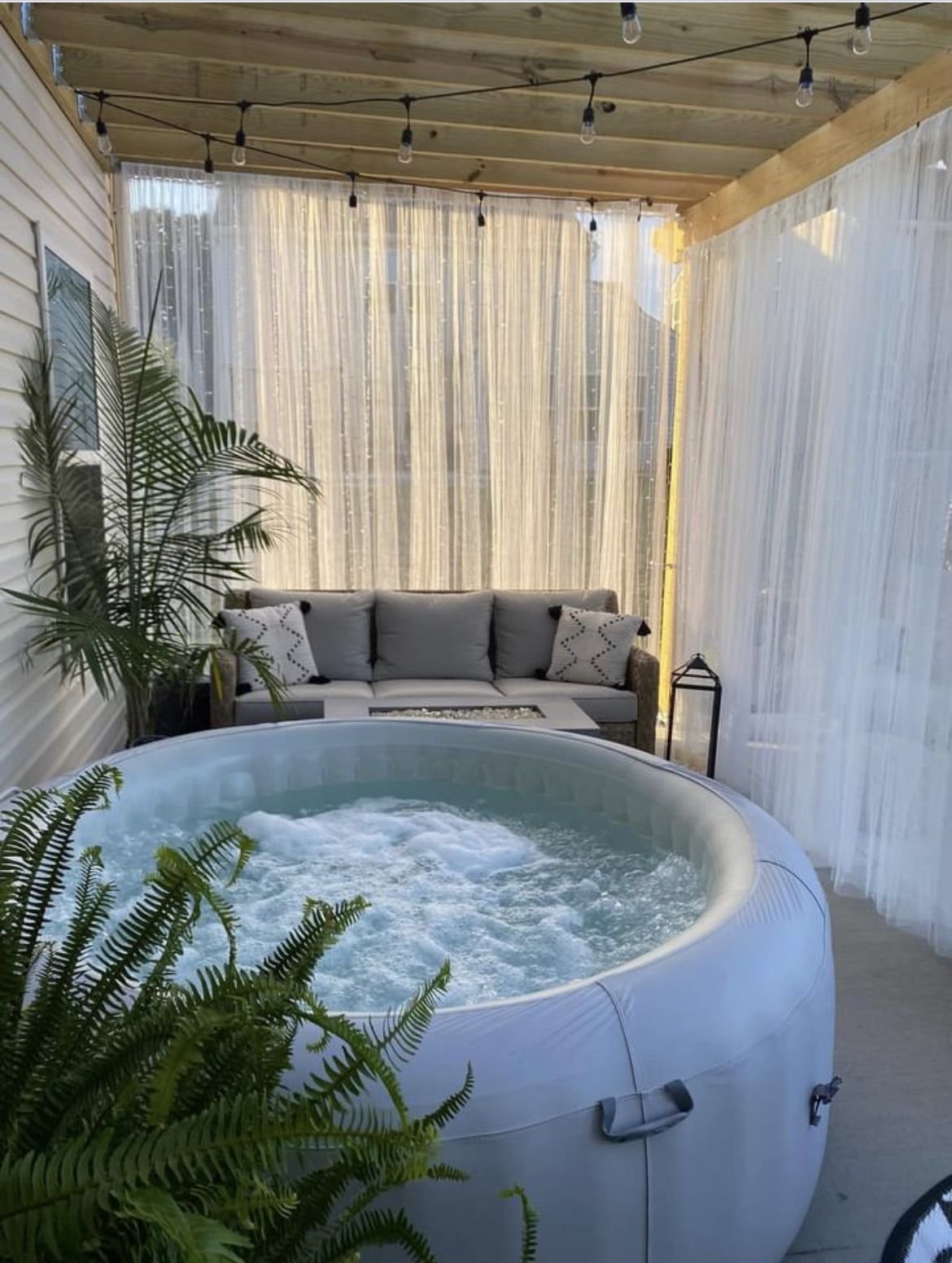
Not just during a party. Not just on perfect weather days. Every single evening.
An outdoor jacuzzi is the single most effective addition for achieving that quality. It provides a concrete reason to be outside, a sensory experience that can’t be replicated indoors, and a focal point around which the rest of the yard’s design can cohere.
The nine ideas below represent the most practical and visually compelling approaches to outdoor jacuzzi design — from the dramatically architectural to the quietly intimate. Each one is adaptable to different budgets, yard sizes, and lifestyle priorities.
Good outdoor seating and string lights work beautifully alongside all of them.
What’s Actually Missing from Your Outdoor Space
When an outdoor space consistently goes unused, the problem is rarely physical. It’s motivational.
There’s simply nothing compelling enough to pull someone away from the indoor default. No experience, no sensation, no ritual that justifies the transition from inside to outside.
An outdoor jacuzzi provides that experience. The physical sensation of warm water on its own is enough to make the outdoor space feel categorically different from anywhere inside the house. Layer good lighting, some privacy, and a considered surrounding design on top of that, and the backyard becomes a genuine daily destination.
Here’s how to build it.
1. The Sunken Jacuzzi That Looks Like It Belongs in a Resort
The sunken jacuzzi achieves something that raised installations cannot: seamlessness.
By recessing the tub into the ground or deck surface, the water meets the surrounding environment without interruption. The yard doesn’t work around the hot tub. The hot tub belongs to the yard.
Functionally, entry is more natural — you step down into the water rather than hoisting yourself over a raised rim. The difference is subtle in description and significant in experience.
Installation complexity is higher: excavation, drainage planning, and structural preparation are involved. The payoff is a finished installation that consistently reads as custom, high-end work regardless of the actual budget spent.
Surround with natural stone or composite decking. Add recessed step lighting at the perimeter. The result at night is genuinely striking.
2. The Pergola-Covered Jacuzzi for Year-Round Luxury
Outdoor jacuzzis without overhead coverage are weather-dependent by definition. An unexpected rainstorm or an unusually hot afternoon can sideline the investment entirely.
A pergola converts a fair-weather feature into an all-season one. Overhead coverage provides shade during peak heat and shelter from light precipitation. Retractable side panels or a louvered roof system extend that coverage to handle a wider range of conditions.
The design benefit extends beyond weather protection. A pergola creates architectural definition around the jacuzzi, transforming an exposed area into a defined outdoor room with distinct character.
Treat the pergola and jacuzzi as one unified design object. Consistent materials, proportional harmony, pendant lighting overhead — together these create something that reads as finished and intentional from every angle.
3. The Japanese-Inspired Soaking Tub Setup
The ofuro, rooted in Japanese bathing tradition, offers a compelling alternative to the standard hot tub format.
Deeper and narrower than a conventional jacuzzi, it’s designed for contemplative immersion rather than entertainment. The experience is focused: heat, stillness, the absence of stimulation.
The design philosophy of the surrounding environment matches that of the tub itself. Bamboo screening. River stones. A single carefully chosen ornamental specimen. Planting focused on texture and calm rather than color or volume.
For smaller yards, this format offers exceptional value per square foot. A compact wooden soaking tub with flanking planters creates a fully realized outdoor sanctuary in a very modest footprint.
For anyone whose primary need from outdoor water is decompression rather than socialization, this is the format worth prioritizing.
4. The Deck-Integrated Jacuzzi That Maximizes Space
Spatial efficiency in backyard design isn’t about size — it’s about integration.
A hot tub placed on an existing deck is an object in a space. A hot tub designed into the deck from the beginning is a feature of the space. The distinction is immediately visible and directly affects how the yard feels to be in.
Integration creates multiple functional benefits simultaneously. The tub becomes a structural anchor around which surrounding deck elements organize naturally. Built-in bench seating, planter boxes, and a drink ledge at tub height all emerge logically from a design that starts with integration as its premise.
Multi-level decking amplifies the spatial intelligence further. A lower tub level and an elevated seating area create visual depth and a sense of scale that makes compact yards read as considerably more spacious than their actual dimensions.
5. The Fire-and-Water Combo That Stops People in Their Tracks
Few outdoor design combinations deliver the consistent sensory impact of fire and water together.
The visual and tactile contrast — the flicker and warmth of open flame meeting the shimmer and heat of outdoor water — creates an atmosphere that feels simultaneously primal and sophisticated.
From a practical standpoint, gas-fueled options are the most accessible. A propane fire pit or gas fire table delivers consistent, controllable flame without wood management, smoke management, or extensive cleanup.
Position the fire feature within comfortable sightlines of the jacuzzi, separated by a safety buffer of stone or gravel. Use the same stone or composite material in both surrounds — this single design decision creates the material continuity that distinguishes a curated outdoor space from a collection of separate purchases.
6. The Garden-Wrapped Jacuzzi for Total Privacy
Privacy is a design requirement for outdoor jacuzzi spaces, not an optional enhancement. Without it, usage patterns deteriorate and the investment underperforms.
Living plant screens outperform structural fencing in most residential backyard contexts. They provide equivalent visual privacy while adding organic texture, seasonal interest, and genuine beauty to the space.
Effective plant screens are built through layering. Taller columnar varieties at the back establish height and coverage. Mid-height ornamental grasses and dense shrubs fill the middle range. Ground cover and low plantings soften the hardscape at the base level.
This layered approach eliminates sightlines from multiple angles while creating the impression of a designed garden rather than a barrier. Climbing plants on a trellis structure add vertical interest and fill in over time with minimal maintenance.
The result is a jacuzzi area that feels genuinely secluded and surrounded by nature rather than enclosed and defended.
7. The Rooftop or Balcony Jacuzzi for Urban Dwellers
The outdoor jacuzzi opportunity is not exclusive to properties with ground-level outdoor space.
Rooftop terraces and load-bearing balconies are legitimate installation platforms, provided the foundational question is answered first and answered properly: does the structure support the load?
This requires a qualified structural engineer’s assessment. A filled hot tub represents significant concentrated weight. Professional verification is the non-negotiable prerequisite, not an optional safety measure.
With that clearance confirmed, the possibilities are compelling. A compact jacuzzi on an urban rooftop with a cityscape backdrop delivers an experience that premium hospitality venues charge substantially for. The distinction is that yours is available nightly, at no incremental cost.
Design the surrounding environment for the constraints of elevated spaces: lightweight planters, solar-powered lighting, and a quality outdoor rug to define the zone without adding unnecessary load or visual clutter.
8. Smart Lighting That Turns Your Jacuzzi Area Into a Night Scene
Outdoor lighting is the highest-leverage variable in the creation of evening atmosphere. It is also the element most frequently underinvested in residential backyard projects.
A single overhead fixture provides functional visibility and almost nothing else. The experience of warm, layered light — multiple soft sources at varying heights — is categorically different.
A complete lighting approach for a jacuzzi area typically includes: LED strip lighting at ground level along deck edges and pathways; solar stake lights in planted beds; weatherproof string lights overhead; lanterns at eye level on structural elements.
Combined with the built-in underwater chromotherapy LEDs included in most contemporary jacuzzi models, the total nighttime effect creates a scene that draws people outside specifically to experience it.
9. The All-Season Setup with a Weather-Proof Enclosure
In climates with defined winter seasons, an outdoor jacuzzi without weather protection has a practical usage ceiling of roughly five to six months annually.
An enclosure raises that ceiling significantly. The right enclosure depends on the severity of local winters and the level of investment that makes sense for the overall project.
At the entry level, a quality insulated cover combined with a windbreak panel on the exposed side extends the comfortable usage window by weeks to months.
At the higher end, a permanent hardtop structure or timber pavilion with insulated panels creates a year-round outdoor room that makes season entirely irrelevant as a barrier.
In both cases, design the enclosure to be visually continuous with the jacuzzi installation. Consistent materials and proportional thinking produce a result that appears planned from the outset.
The Path from Imagined to Built Is Shorter Than It Seems
The distance between a backyard that performs and one that doesn’t is usually not physical distance. It’s a decision.
A decision to commit to one approach. To act rather than continue accumulating information. To build something real from the options available right now rather than waiting for perfect conditions.
You don’t need the full list. You need the idea that best matches your yard, your lifestyle, and what you can act on today.
Start there. The outdoor furniture and ambient lighting that complete the scene will find their natural place around something worth building toward.
The retreat you’re picturing is closer to achievable than it feels.