
Disclosure : This post may contain affiliate links or paid partnerships. I may earn compensation if you click a link or make a purchase, at no additional cost to you. See my disclosure for more info.
There’s a specific kind of frustration that comes from a living room that’s almost right.
The proportions are fine. The furniture is comfortable. The colors are cohesive. But something about the room still feels unfinished—lacking a sense of arrival. Like the space is waiting for something that hasn’t arrived yet.
In most cases, that something is a fireplace.
Not just any fireplace—one that actually fits the room, the lifestyle, and the aesthetic.
The problem is that “choosing a fireplace” sounds simple and turns out to be anything but. Gas versus electric versus wood. Built-in versus freestanding. Stone versus tile versus plaster versus concrete. Every decision leads to more decisions.
And once you commit, you’re committed. A poorly chosen fireplace is permanent-feeling. Expensive to undo. Hard to look at every single day.
This guide is the shortcut you’ve been looking for.
Thirty-plus fireplace designs, sorted by category and style, with clear explanations of where each works best. By the end of this guide, you’ll have moved from “overwhelmed” to “decided.”
Stop Choosing Fireplaces the Wrong Way
The single most common fireplace design mistake is choosing based on aesthetics alone.
It feels like the natural starting point—of course you look at photos first. But it produces bad results because a fireplace that looks perfect in one room can look completely wrong in another.
Why? Because room scale, architecture, and function determine which designs work, not personal taste in isolation.
A massive stone installation in a small, low-ceilinged apartment doesn’t feel cozy. It feels suffocating.
A thin, minimalist linear fireplace in a warm, traditionally decorated home doesn’t feel modern. It feels out of place.
Before you fall for anything in this guide, take three minutes to do this: measure your wall, consider your ceiling height, and decide whether you want actual heat output or primarily visual warmth and ambiance.
Those three data points will instantly narrow your choices to the designs that can actually succeed in your room.
Modern Fireplace Designs for Clean, Contemporary Living Rooms
1. Linear gas fireplace recessed into the wall.
The most referenced design in contemporary interior photography. A wide, horizontal flame behind glass, flush with the wall surface, with no competing mantel or surround. Pure fire, pure architecture. Requires a wall span of at least eight feet to read correctly.
2. Borderless electric insert for an existing opening.
The solution when renovation isn’t an option. These units slide into existing firebox openings or mount flat on the wall surface. The flame simulation in current models is significantly more convincing than most people expect.
3. Continuous poured concrete from floor to ceiling.
Industrial-scale impact. A seamless concrete form climbing the full height of the wall creates a monumental focal point that no piece of furniture can compete with.
4. Blackened steel surround with a lean cantilevered shelf.
A precise steel frame around the firebox, paired with a slim floating shelf above. The combination looks expensive but is achievable through a custom metal fabricator at a price that won’t shock you.
5. Inset gas ribbon burner along the wall plane.
A long, narrow aperture of flame sunk into the wall, reading as an architectural element rather than an applied feature. Gas-powered with professional installation required, but visually unlike anything else in this category.
Rustic and Natural Material Fireplaces for Warm, Character-Rich Rooms
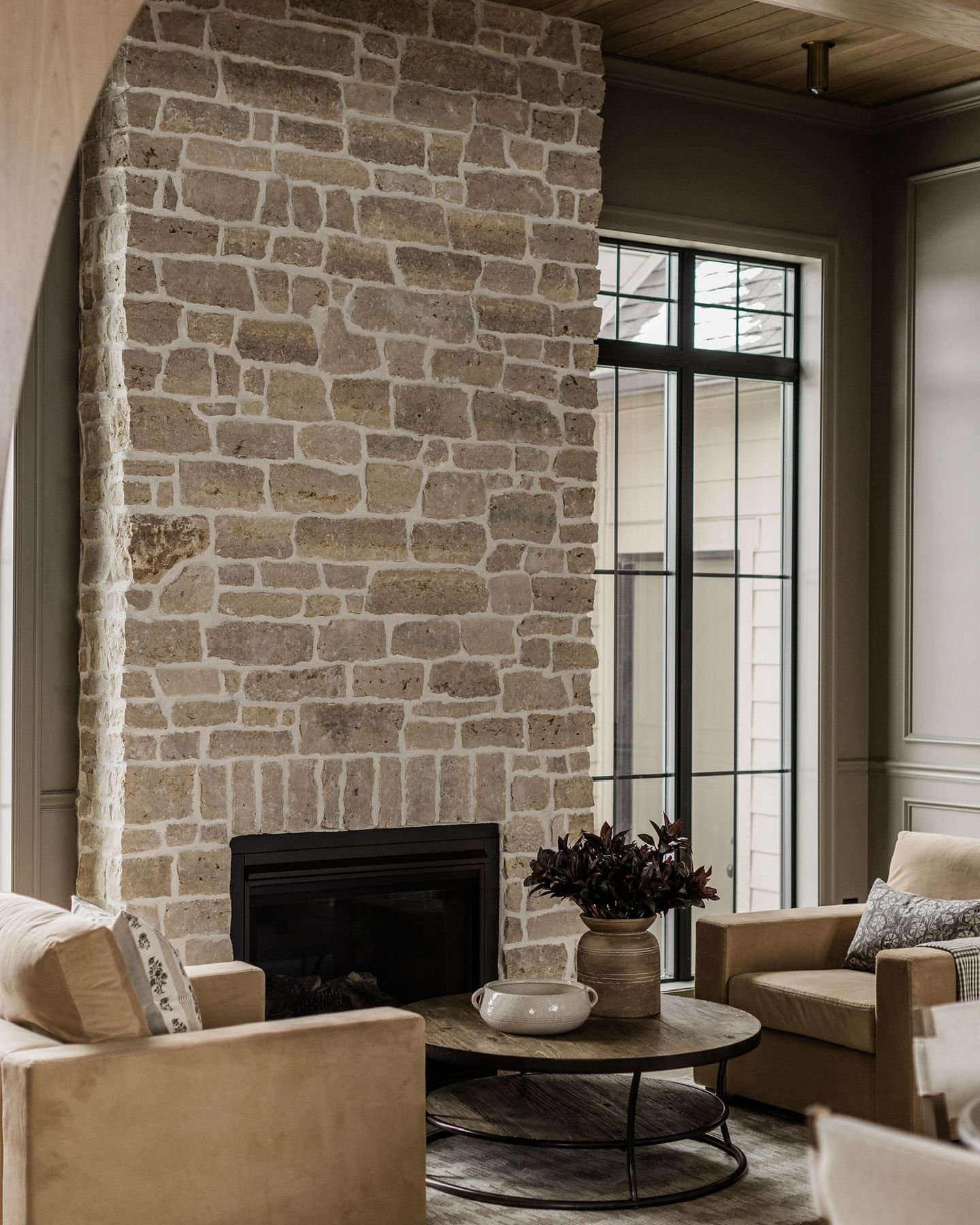
6. Natural stacked stone running from floor to ceiling.
The iconic statement of rustic residential design. Natural stone laid continuously from the floor to the ceiling creates a sense of warmth and permanence that no manufactured material reproduces.
7. Reclaimed wood beam mantel.
A single salvaged timber beam above the firebox opening accomplishes what years of decorating cannot: it gives the room a sense of history and genuine material character.
8. Diluted white paint wash over existing brick.
The technique that resolves the “brick too heavy, but I want to keep the texture” dilemma. A diluted white paint wash preserves the surface character of the brick while softening its visual weight considerably.
9. Smooth rounded river stone cladding.
Where angular stacked stone reads as rugged and assertive, smooth river stone reads as organic and calm. It pairs naturally with warm timber floors and neutral, nature-inspired color palettes.
10. Vintage cast iron wood-burning insert.
This is the option that delivers on every practical and aesthetic front simultaneously. A cast iron insert in an existing hearth gives you genuine combustion, substantial radiant heat output, and a character that contemporary units spend a fortune trying to approximate.
Fireplace Designs That Transform the Entire Wall
The fireplace doesn’t have to exist in isolation.
The wall it sits on is the most visually dominant surface in the living room. Designing that wall as a complete composition—rather than just a background for the firebox—is how you move from “nice fireplace” to “incredible room.”
11. Symmetrical built-in shelving flanking both sides of the firebox.
Custom built-in shelves running the full height of the wall on each side of the fireplace turn the entire wall into a unified architectural feature. Books, art, plants—the shelves make it all purposeful.
12. Hidden TV cabinet above the mantel.
The television-above-fireplace arrangement doesn’t have to dominate the room when the screen is off. Cabinet doors that close over the TV preserve the wall’s visual calm outside media hours.
13. Integrated firewood cubby beneath the firebox.
A recessed opening below the firebox holding a neat stack of split logs. Practical, visually rich, and it signals that the fireplace is actually used—which makes a room feel more alive.
14. Flanking window seat benches with under-seat storage.
Upholstered benches built symmetrically into both sides of the fireplace wall, with concealed storage beneath the seats. Cozy seating, hidden organization, and strong architectural symmetry all in one feature.
Statement Fireplace Designs for Rooms That Want to Impress
Not every fireplace should blend in.
In some rooms, the right approach is to let the fireplace set the entire agenda—to be the thing the room is built around.
Here are the designs for those rooms.
15. Double-sided see-through fireplace.
Visible from two adjacent rooms at once. It divides a space without fully separating it, maintaining a visual and thermal connection between the living room and the dining room.
16. Ceiling-suspended pendant firebox.
A conical or cylindrical fire vessel hanging from the ceiling on an exposed flue. Three-dimensional, sculptural, and impossible to ignore.
17. Tall arched firebox opening.
A pointed or rounded arch above the firebox replaces the standard rectangular format with something that references ecclesiastical and classical architecture. The effect is instantly more formal and dramatic.
18. Full-height dark marble surround.
Book-matched dark-veined marble running from the floor to the ceiling of the fireplace wall. This is the design equivalent of a formal declaration—luxury, plainly stated, without requiring a single object on the mantel to make its case.
19. Indoor-outdoor glass wall fireplace.
A firebox built into the glass wall between the living room and a terrace, with the flame visible from both sides. Technically complex to plan and build, but nothing else creates this particular experience.
Budget-Conscious Fireplace Transformation Strategies
Sometimes the problem isn’t the absence of a fireplace.
It’s the presence of one that looks tired, dated, or wrong for the room. The good news is that some of the most effective improvements cost a fraction of what a full replacement would.
20. Paint the brick surround in a deep, confident color.
Charcoal, navy, or deep green applied over old brick completely resets the fireplace’s visual register. It’s one of the highest-ROI home improvements that exists, measured by impact per dollar spent.
21. Peel-and-stick tile overlay on an outdated surround.
Modern adhesive tile systems replicate marble, zellige, and ceramic convincingly. The installation is accessible to most homeowners and requires no specialist tools.
22. Replace the mantel in isolation.
When the surround and firebox are structurally sound, replacing only the mantel—trading a dated shelf for a contemporary floating version—reshapes the fireplace’s character without touching anything else.
23. Install oversized artwork or a mirror above the mantel.
When the fireplace itself is fine but the wall above it is creating the problem, a large leaning mirror or a bold artwork resolves it entirely.
24. Add a decorative fire screen as a styling intervention.
A well-proportioned screen with strong visual character turns an undifferentiated firebox into something that looks deliberately selected and styled.
Electric Fireplace Solutions for Homes Without Gas or Chimney Access
The absence of a chimney or gas line is genuinely no longer a limitation.
Electric fireplace technology has advanced far enough that the best available options are convincingly realistic and architecturally appropriate for high-quality interiors.
25. Wide-format recessed electric insert.
Panoramic units spanning three feet or more mount recessed into the wall, delivering a realistic flame effect at a scale appropriate for living room walls. This wall-mounted model represents the current state of the art.
26. Electric fireplace integrated into a custom feature wall.
A feature wall combining custom shelving, a television positioned above eye level, and an electric fireplace at the base creates a fully designed, architecturally resolved installation without any gas work.
27. Freestanding electric stove unit.
A compact, portable unit that references the form and character of traditional cast iron wood stoves. Standard outlet power, genuine supplemental heat, no installation. The Country Living Smart Infrared Electric Fireplace Stove is among the most convincing versions available.
28. Credenza with integrated electric flame for dining rooms.
A low storage credenza with a built-in flame element at its base extends fireplace ambiance beyond the living room into dining and entertaining spaces.
Less Common Fireplace Details That Create Genuine Distinction
These are the details that make people ask questions.
29. Tempered fire glass replacing conventional log media.
Crushed fire glass in cobalt, emerald, copper, or clear tones replaces the standard ceramic log set. The way it catches and refracts flame light is immediately contemporary and visually arresting.
30. Graduated pillar candles inside an inactive firebox.
An unused hearth opening furnished with pillar candles of varying heights. One of the most atmospherically effective things you can do with an inactive fireplace at minimal cost.
31. Artisan plaster or lime-based finish on the surround.
A hand-troweled plaster finish creates organic tonal variation and surface texture that no manufactured product can replicate. Currently one of the most specified finishes in high-end residential fireplace design.
32. Decorative tile covering the complete fireplace wall.
Zellige, glazed Portuguese azulejo, or encaustic cement tile covering the entire wall around the firebox transforms the hearth from a functional feature into an artwork-level decorative installation.
33. Cantilevered concrete or stone hearth slab.
A hearth slab that projects from the wall without visible support below it. Understated in photographs; quietly remarkable in person.
How to Apply This Guide to Your Specific Situation
Reading about thirty-three fireplace ideas is only useful if you can connect the right one to your room.
Here’s the framework:
Small room: A wall-mounted electric unit or a proportionate simple surround. Large installations need spatial volume to function without overwhelming.
Open floor plan: Double-sided or linear designs mark spatial transitions without creating physical barriers.
Traditional home: Stone, brick, and natural timber mantels align with and support the existing architecture.
Contemporary home: Minimal surrounds, linear flames, and flush integration reinforce modern spatial language.
Limited budget: Paint, adhesive tile, and a replacement mantel shelf deliver meaningful transformation for under one hundred dollars when targeted at the right element.
The goal is to match the design to your room’s actual conditions. The best fireplace is the one that performs correctly in your specific context.
The Fireplace Is Where Your Living Room Finally Comes Together
Most people think of a fireplace as a feature within a room.
It isn’t. It’s the organizing principle of the room. It’s what determines where people sit, where their eyes go first, and how the space feels when nobody’s doing anything in it.
Get it right, and everything else—the sofa, the coffee table, the lighting, the art—falls into a natural, satisfying relationship.
Get it wrong, and no quantity of careful styling addresses the fundamental gap.
You now have thirty-three specific, actionable options in front of you. Each one is real and executable—whether through a contractor, a weekend project, or a single product purchase.
Choose the one that fits your room and start from wherever you are. A set of candles in the firebox, a coat of paint on the brick, a new mantel shelf.
The room you’ve been trying to create starts at the hearth.