
Disclosure : This post may contain affiliate links or paid partnerships. I may earn compensation if you click a link or make a purchase, at no additional cost to you. See my disclosure for more info.
Every property has at least one outdoor space that isn’t earning its keep.
A strip of unused lawn. A side passage with no function. A corner of the garden that collects things nobody wants and everyone ignores.
A plunge pool is consistently one of the highest-value interventions available for outdoor spaces. It delivers daily use, increases property appeal, and transforms how your home feels to live in — without the footprint or cost of a full swimming pool.
That last distinction matters. A plunge pool is engineered for compact spaces and real-world budgets. It’s not a scaled-down version of something larger. It’s its own thing, optimized for soaking, cooling, and outdoor enjoyment.
Here are nine designs that deliver real value, and the planning errors that erode that value before a pool ever gets used.
The Value Proposition: Plunge Pool vs. Swimming Pool
Understanding the difference shapes everything that follows.
A plunge pool is compact in footprint and deeper in profile than a conventional swimming pool. It’s engineered for immersive soaking and temperature therapy, not lap swimming.
Standard dimensions — 6 to 15 feet long — make it viable for urban lots, courtyard gardens, and compact suburban backyards where a conventional pool would never fit.
The operational advantages compound over time: lower heating costs, simplified maintenance, and significantly faster installation timelines than a full-sized pool.
These are genuine financial advantages, not just incidental benefits.
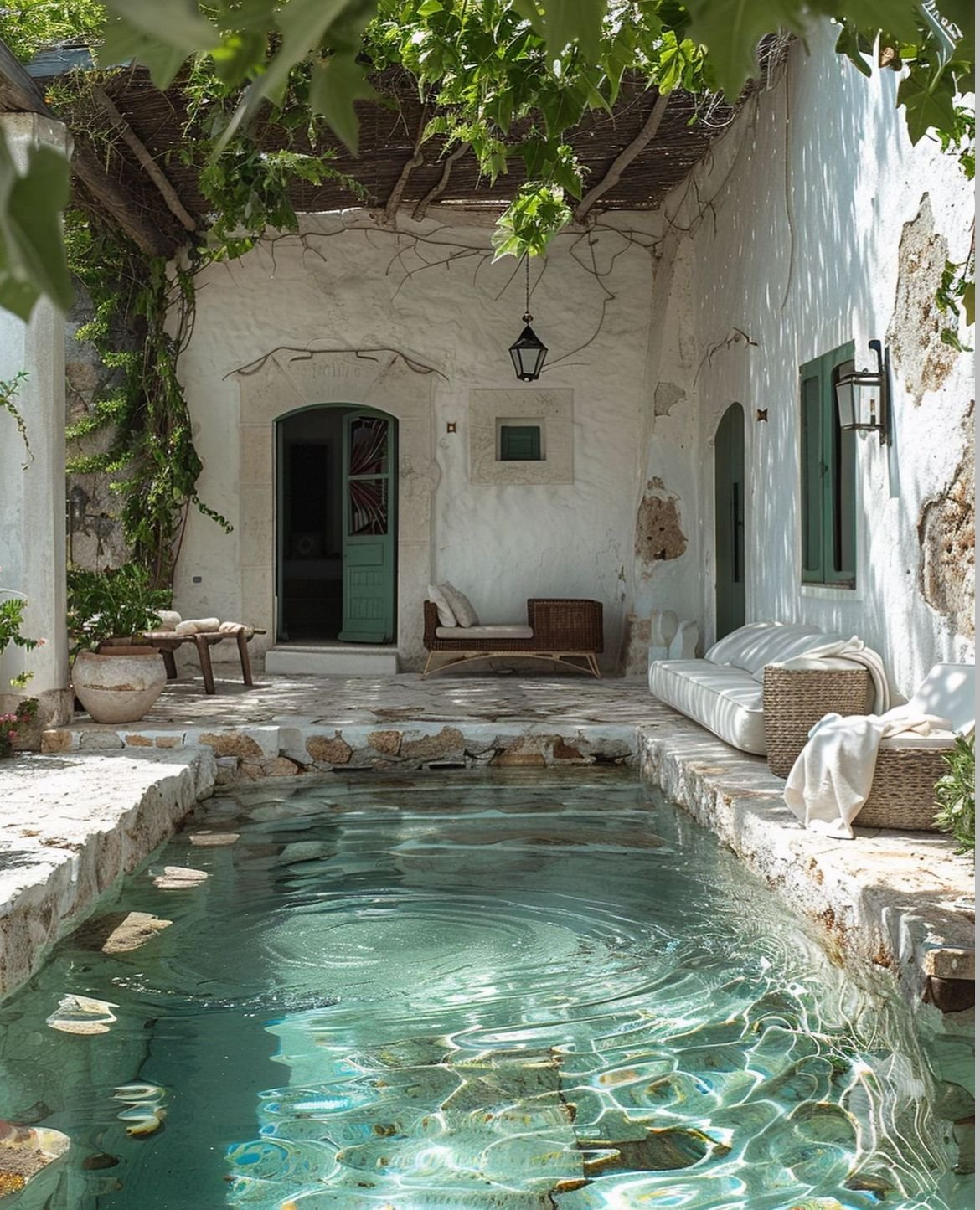
1. The Natural Stone Plunge Pool
For properties where natural materials already define the aesthetic, a stone plunge pool delivers the best return on visual investment.
Materials like flagstone, travertine, and limestone integrate naturally into established garden schemes. Irregular edges. Earth-tone palettes. Low planting threading through the joints.
The result reads as organic rather than installed — a quality that tends to age well and require no stylistic justification over time.
Practical advantage: stone surfaces retain less heat underfoot under direct sun than most manufactured alternatives. That’s a comfort benefit that gets used daily from spring through autumn.
This style suits cottage gardens, Mediterranean landscapes, and rural properties where geometric hard landscaping would look misaligned. It’s a design that earns its value quietly and accumulates appreciation over time.
Layer the surrounds with landscaping rocks in complementary earth tones, vertical garden panels along the boundary, and chaise lounges on the stone deck for functional lounging adjacent to the pool.
2. The Plunge Pool With a Built-In Sitting Ledge
One specification detail delivers disproportionate value relative to its cost: an integrated underwater bench.
Without it, a plunge pool lacks a comfortable resting position inside the water. The user experience suffers. Use frequency decreases.
With a bench running along one wall, or configured as an L-shape across two, the pool gains a dedicated seating position that makes extended soaking comfortable and the pool genuinely functional as a social space.
The shallower zone this creates also extends the pool’s usability to younger children and guests who prefer not to stand in deep water.
This is a high-yield specification item at a cost that consistently surprises homeowners who assumed it would be prohibitive.
Add an in-pool stool at the pool edge for poolside seating, a striped indoor/outdoor rug to anchor the deck zone visually, and patio side tables for functional surface space.
3. The Freeform Plunge Pool With Lush Tropical Plants
For homeowners whose primary goal is experiential value — a space that genuinely feels like a retreat — the freeform tropical design delivers more than any rectilinear alternative.
A non-geometric pool form — oval, kidney, or fully organic — surrounded by dense tropical planting produces an environment that functions as a complete sensory alternative to indoor spaces.
The plant palette does significant design work: palms, birds of paradise, broad-leaved tropicals, and boulders for scale and textural contrast.
The spatial benefit is measurable: curved forms optically expand compact yards. Organic perimeter lines read as more generous than rectangular equivalents at the same actual dimensions.
For properties with coastal or tropical character, this design integrates visually as if it was always part of the original plan.
Establish vertical scale with areca palm trees, install a cedar vertical garden along the rear boundary for density and privacy, and add outdoor globe string lights to extend the functional value of the space into evening hours.
4. The Raised Concrete Plunge Pool
Sloped sites present challenges for conventional pool installation. The raised concrete design converts those challenges into structural and visual advantages.
A partially or fully above-grade pool eliminates the need for deep excavation on difficult terrain. The resulting structure — clean, geometric, architecturally considered — reads as a deliberate design decision rather than a site constraint.
Exterior cladding in stone, render, or timber allows integration with the existing material palette of the home and garden.
Functional value: raised perimeter walls provide continuous informal seating at no additional footprint cost. This directly increases the social utility of the pool surround.
Financial consideration: where site topography drops away from the main structure, a raised build can cost meaningfully less than an in-ground alternative because significant excavation costs are eliminated.
A louvered aluminum pergola alongside provides shade and defines an outdoor room. An indoor/outdoor area rug in the adjacent seating area completes the spatial organization.
5. The Plunge Pool Woven Into a Deck
From a spatial efficiency standpoint, the deck-integrated design delivers the highest return for any given outdoor footprint.
The pool is positioned within a continuous deck surface so that water and living plane read as a single cohesive element. Direct deck-to-water access. No transition detail. No material interruption at the pool edge.
The deck operates simultaneously as circulation space, social area, and pool surround — eliminating the need to dedicate separate square footage to each function.
The defining technical detail is the flush rim: pool coping level with deck surface, maintained as a single horizontal plane. This is the feature that produces the spatial expansion effect the design is known for.
Non-negotiable safety specification: slip-resistant surface treatment at the water’s edge. Smooth composite decking when wet creates a meaningful fall risk. This is an engineering and insurance consideration, not an aesthetic preference.
Teak pool chaise lounges and a shade sail complete the upper deck level. A outdoor side table between loungers adds necessary functional surface without cluttering the space.
6. The Cocktail Plunge Pool Fitted With Jets
Annual utilization rate is the most practical measure of a plunge pool’s long-term value. By that metric, the cocktail pool consistently leads the category.
The cocktail pool — commonly referred to as a “spool” — combines a compact plunge pool footprint with hydrotherapy jet systems and temperature regulation capability. The result is a year-round installation rather than a seasonal one.
Cooling function in summer. Therapeutic heated soaking in winter. One installation, two operational modes, twelve months of use.
For homeowners in climates with genuine cold seasons, this design typically generates significantly higher annual return on investment than any pool configured for summer use only.
Standard dimensions — 10 to 12 feet — accommodate the required mechanical systems while remaining viable in most residential lots without dominating the available outdoor space.
Position a large cantilever umbrella overhead for year-round shade management. reclining chaise lounges facilitate easy transitions from water to outdoor seating. outdoor string lights extend usable hours into the evening.
7. The Glass-Paneled Plunge Pool
For homeowners where visual impact and property differentiation are primary goals, the glass-paneled design achieves outcomes unavailable to any other configuration.
Engineering-grade acrylic panels replace structural wall sections, making the water column visible from outside the pool. The resulting visual effect is simultaneously architectural and theatrical.
Maximum impact is achieved when the pool is raised or semi-raised, with the transparent panel oriented toward the primary seating axis or viewing position.
The underwater LED lighting system at night creates a luminous focal point of considerable atmospheric power.
The investment is real: thick acrylic panels, structural engineering review, and careful waterproofing detailing are genuine cost items. There is no value in understating this.
For homeowners willing to make that investment, the return — in property differentiation, in guest experience, in daily visual satisfaction — is equally real.
8. The Japanese-Inspired Deep Soaking Pool
The Japanese soaking pool represents an established design typology with documented origins spanning centuries — and one that delivers distinctive value in contemporary residential settings.
The form is deliberately minimal: a rectangular basin, dark stone or tile, and occasionally a bamboo spout delivering a continuous water stream across the surface. The restraint is the design.
The functional logic prioritizes depth over surface area, enabling full-shoulder immersion in a structure as compact as 7 feet across. This is an important efficiency advantage for constrained sites.
Surrounding landscape elements — raked pebbles, ornamental grasses, a simple timber privacy screen — complete an environment that functions as a genuine retreat rather than simply a water feature.
Operational efficiency note: dark-colored tile exhibits higher solar absorptivity. In temperate and warm climates, this translates to passive solar heating that measurably reduces mechanical energy consumption — a long-term operational cost advantage worth factoring into material specification decisions.
9. The Courtyard Plunge Pool
Constrained outdoor spaces — narrow side corridors, enclosed courtyards, compressed urban lots — are frequently dismissed from consideration for pool installation.
The courtyard plunge pool demonstrates consistently that this dismissal is premature.
A slim rectangular pool — 5 feet in width, 12 feet in length — can be installed in spaces previously categorized as non-functional and produce a result that becomes the most-used outdoor area on the entire property.
The formula is repeatable: vertical garden on the boundary wall, warm lights overhead, loungers positioned alongside the pool.
The functional transformation — from dead corridor to active retreat — consistently represents the highest impact-per-square-foot outdoor improvement available to terrace homes and urban townhouses.
Spatial constraints are a design prompt, not a veto. The best constrained-site solutions routinely outperform their unconstrained equivalents in satisfaction and daily use.
The Errors That Erode Plunge Pool Value
Understanding where plunge pool projects fail is as important as understanding where they succeed.
Error 1: Omitting the permit process.
The assumption that a plunge pool falls below the regulatory threshold for building approval is incorrect in most jurisdictions. Any permanent in-ground water structure requires a building permit. Proceeding without one creates financial and legal exposure that can materially affect both the enjoyment and the resale value of the property.
Contact the local building authority before any site work is commissioned.
Error 2: Insufficient drainage design.
Bather displacement volume must be managed through engineered overflow systems and proper site grading. Without this, water migrates to foundations, adjacent properties, or planting beds. This is an engineering problem that must be resolved at the design stage to avoid ongoing maintenance and structural issues.
Error 3: Underspecifying filtration systems.
Plunge pools have lower water volume than conventional pools. This means chemical imbalances occur with greater speed and severity. An undersized or underpowered filtration system produces chronic water quality failures that reduce pool use and create recurring costs.
Specify a filtration and sanitation system properly matched to the pool’s actual water volume. This is a non-negotiable investment in functional longevity.
Error 4: Failing to incorporate shade.
A plunge pool in unbroken direct sun accumulates heat through the day. By peak summer temperatures, the water can become uncomfortably warm — defeating the pool’s primary function. Shade provision is a functional requirement, not an optional upgrade.
Budget for a shade sail, pergola, or large umbrella from the outset of the project, not as an afterthought once the pool is in use.
Selecting the Optimal Design for Your Situation
Effective design selection requires clarity on three variables.
Available site area: measure the actual usable space. Visual estimates consistently produce undersized or oversized designs that compromise performance.
Intended use pattern: daily refreshment, social entertaining, and year-round therapeutic soaking each point toward a different optimal configuration. Honest assessment of actual use habits drives better decisions than aspirational ones.
Existing property aesthetic: design coherence between pool and property produces the strongest long-term satisfaction. A pool that conflicts with the visual language of its surroundings will consistently underperform a well-integrated one, regardless of technical execution quality.
Define these three variables accurately and the viable design options narrow considerably. The right choice tends to become self-evident.
The Return on Investment Starts the Day You Start Using It
Residential outdoor space consistently represents significant underutilized asset value.
Most homeowners spend substantial time and money on their property, but treat the outdoor space as secondary — maintained but not truly used. Not invested in as a place to actually live.
A plunge pool converts underutilized outdoor space into daily-use living space.
It changes how the property is experienced. It gives residents a reason to be outside intentionally. It creates a social space that actually gets used. It makes the property worth what it costs to own — not just on paper.
The requirements are well within reach for most homeowners: a realistic plan, a design that fits the actual site, and the commitment to act on it.
The outdoor space has been waiting for that commitment. This is a good time to make it.