
Disclosure : This post may contain affiliate links or paid partnerships. I may earn compensation if you click a link or make a purchase, at no additional cost to you. See my disclosure for more info.
Here is the problem with most backyard hot tub installations: they’re built for July.
The tub goes in. Summer is glorious. Then September arrives, and the soaks get shorter. October feels like a commitment. By November the cover is on and the chemicals are adjusted for storage. By April you’re wondering if this was a good idea.
That’s not a hot tub problem. That’s a setup problem.
The right outdoor jacuzzi design — the right materials, the right shelter, the right orientation — makes winter soaking not just possible but genuinely preferable. There is a particular quality to an outdoor soak in cold weather, with steam rising off the water and string lights glowing against a dark sky, that summer simply cannot replicate.
These 20 outdoor jacuzzi ideas are chosen for year-round performance — setups that work as well in January as they do in June, and that give you a reason to be outside in every season.
Let’s find your setup.
20 Jacuzzi Setups Built for Year-Round Outdoor Living
1. Sunken Hot Tub That Works in Any Season
A flush-set sunken hot tub has one seasonal advantage that above-ground installations don’t: in winter, the deck surrounding it traps radiant warmth as you stand at the edge, making entry and exit far more comfortable when the air temperature drops.
The recessed design also reduces wind exposure at the water surface — an important factor in climates with cold-season winds. The lower the tub sits relative to the surrounding surface, the less wind reaches the water.
Plan access panels into the build from the start — winter pump failures happen and being unable to reach the equipment bay is a problem in any season.
2. Windbreaking Pergola for Cold-Season Soaking
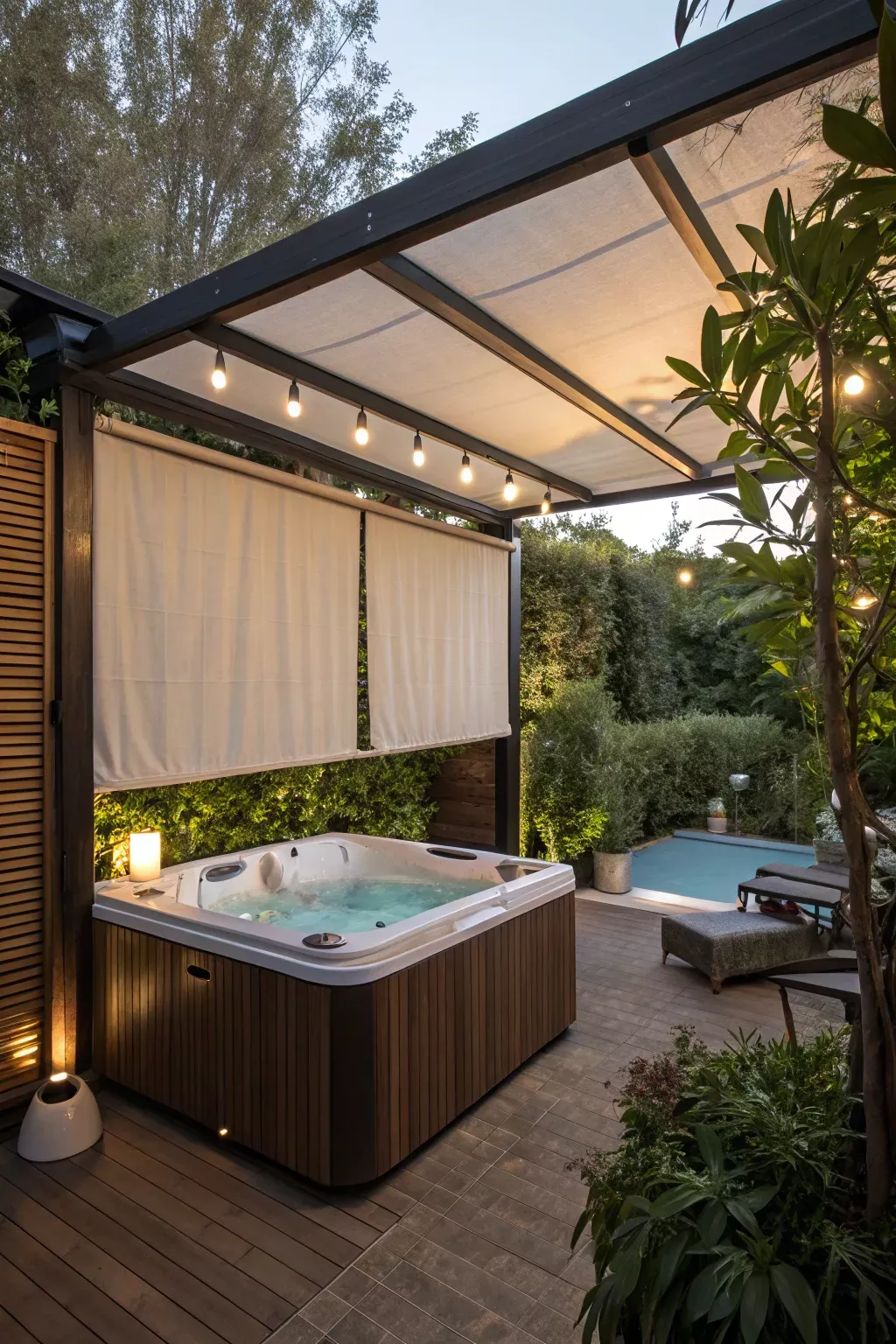
Wind is the primary enemy of comfortable outdoor soaking in cold weather. A pergola breaks the wind above and beside the hot tub, extending comfortable soaking temperatures by several degrees in practice.
Hang drapes on the windward sides during the cold season and retract them in summer. The same structure that provides shade in July provides wind protection in November. One installation, twelve months of function.
Cedar or redwood pergolas are the correct material for this — they handle freeze-thaw cycles without deteriorating, and they look better rather than worse as cold seasons accumulate.
3. Thermal Stone That Retains Heat
Natural stone surrounding a hot tub has a practical cold-weather function: thermal mass. Stone absorbs warmth during the day and radiates it slowly through the evening, keeping the immediate area around the hot tub several degrees warmer than it would otherwise be.
Dark stone — slate or basalt — absorbs the most solar energy during the day. In climates with cold sunny winters, the thermal contribution of dark stone surrounds to evening soaking comfort is genuinely measurable.
4. Year-Round Japanese Garden Setup
A Japanese soaking garden is one of the rare outdoor spa designs that actually improves with the seasons rather than merely tolerating them.
The gravel base is unaffected by frost. bamboo fencing is surprisingly cold-hardy and maintains its structure through winter. The right specimen plant — a Japanese black pine, an ornamental plum — is specifically beautiful in winter, bare branches against snow and steam.
Winter is the season for which this design was originally conceived. A Japanese soaking garden in February is not a compromise — it’s the full expression of the concept.
5. Rooftop or Elevated Deck for Winter Sky Views
If there is a single season when an elevated hot tub justifies itself completely, it’s winter.
The winter sky — clear, dark, full of stars that warm-weather haze obscures — is experienced most completely from an elevated position, surrounded by steam, with nothing between you and the horizon but cold air. This is one of those experiences that genuinely requires no explanation to anyone who has had it.
Structural engineering confirmation is mandatory before any elevated installation proceeds. Confirmed load capacity for the specific filled weight of your tub with occupants is a non-negotiable planning step.
6. Earth-Insulated Hillside Installation
From an energy efficiency standpoint, hillside integration is the most thermally effective hot tub installation method available. The earth surrounding the tub on two or three sides provides constant, passive insulation that no manufactured insulation can replicate at scale.
In practical terms: a hillside-integrated hot tub costs meaningfully less to heat in winter than a freestanding unit in the same location. The insulating effect of the surrounding earth reduces heat loss continuously, lowering operating costs across every cold month of the year.
7. Fire Pit Pairing for Cold-Weather Magic
The fire-and-water combination exists at its absolute best in cold weather. In summer, a fire pit next to a hot tub is pleasant. In winter, it becomes something entirely different.
Exit the water in near-freezing air. The fire ten feet away is not optional — it’s the difference between a genuinely pleasurable experience and a desperate dash for a towel. The contrast between hot water, cold air, and fire warmth in winter is one of the most fully sensory outdoor experiences available without leaving your property.
A gas fire pit ignites in seconds regardless of temperature. For cold-season use, convenience matters — wood-burning requires management that isn’t always welcome at 10 PM in January.
8. Infinity Edge in Winter Landscape
Infinity-edge hot tubs are marketed on their summer appeal — views, blue water, warm evenings. But their most stunning appearances are often in winter, when the visual contrast between steaming water and a bare winter landscape creates an image that no summer version can match.
If your property has a view of hills, water, or forest that is particularly dramatic in winter, an infinity-edge installation amplifies that seasonal drama in a way that standard installations simply cannot.
9. Evergreen Privacy Screen for All-Season Coverage
Deciduous plants make beautiful privacy screens in summer and reveal everything they were hiding in winter. For year-round outdoor soaking, evergreen plantings in vertical garden panels — trailing ivy, holly fern, dwarf heavenly bamboo — maintain coverage and texture through all four seasons.
The sound-dampening quality of a planted screen is also present in winter, when ambient noise can be more intrusive than in summer. A dense evergreen screen keeps your outdoor soaking space quiet and private in February as well as June.
10. Year-Round Swim Spa: The Best Cold-Climate Choice
For homeowners in climates with genuine winters, a swim spa is not just an option — it’s the most defensible choice on this entire list.
Traditional pools are liabilities in winter: expensive to winterize, dormant for months, requiring reopening costs and time in spring. A swim spa is fully functional at any temperature, consumes reasonable energy to maintain, and fits under a simple winter cover between sessions.
Swimming against the current in February, then sliding to the soaking end, is a radically different experience from what summer offers — and a better one in its own way.
11. Tropical Theme in Cold-Climate Contrast
There is something unexpectedly compelling about a fully realized tropical hot tub setup in a cold climate. Tiki torches lit against January darkness. Steam rising from lava-rock-bordered water. A palm in a container, protected by the warmth of the tub’s radiant heat.
The contrast of the tropical theme against the cold-climate context is precisely what makes it striking in winter. Committing to a warm-climate aesthetic in a cold-climate setting creates a year-round visual tension that most outdoor spaces lack entirely.
An outdoor shower with a rainfall head works beautifully even in cold weather — warm water, cold air, outdoor sky. The contrast is the point.
12. LED-Lit Concrete for Long Dark Evenings
In northern climates, the evenings are long. Darkness falls by 4:30 PM in December. A hot tub area that looks spectacular at night is, for most of the year, a hot tub area that looks spectacular during prime soaking hours.
Poured concrete surround with Color-changing LED lights beneath the rim, facing down — the floating glow effect works in rain, in snow, in fog. The more dramatic the weather, the more dramatic the light looks against it. This is a winter setup that rewards winter use.
13. Planted Windbreak Forest Enclosure
Tall ornamental grasses and evergreen arborvitae do their most important work in the cold season: they block the wind that would otherwise make outdoor soaking unpleasant regardless of water temperature.
A dense planted perimeter around the hot tub reduces wind exposure substantially. The temperature inside a well-planted soaking enclosure can feel five to eight degrees warmer than the open yard on a windy winter night. That difference is the difference between a comfortable soak and a brief one.
14. Tiered Deck With All-Season Materials
A tiered deck with the hot tub on the lowest level naturally shelters the soaking zone from prevailing winds in most yard configurations. The upper levels create a wind shadow above the lower one — useful in every cold-season soak.
Composite decking is the only correct material choice for year-round outdoor use in climates with freeze-thaw cycles. Hardwood ipe is an alternative — it handles temperature variation well — but composite is lower maintenance across the full seasonal range. seating on the middle tier should be outdoor-rated for cold-season use as well.
15. Protected Courtyard for Wind-Free Soaking
The interior courtyard of a U- or L-shaped home is, in cold weather, one of the most effectively sheltered outdoor spaces available without additional construction.
Three building walls block wind on three sides completely. The space inside is often several degrees warmer than the open yard and substantially calmer on windy days. Add oversized planters with cold-hardy evergreens, outdoor curtains on the open side for additional wind protection, and candle lanterns for evening atmosphere.
This is the year-round outdoor soaking configuration that homeowners with this architecture almost always have and almost never use.
16. Weathered Bohemian Spa Corner
Bohemian outdoor design improves with age and use — which makes it among the most appropriate aesthetics for year-round outdoor spaces.
Macramé wall hangings that develops a patina. Handmade tile that ages gracefully. outdoor rugs that shows wear. A wooden bench that develops the silver-grey of weathered wood.
The bohemian aesthetic is not diminished by winter use. It is deepened by it. A space that shows evidence of year-round use looks more cared for and more genuine than one that’s covered and stored for six months of the year.
17. Hardtop Gazebo: The Year-Round Solution
Of all the designs on this list, the hardtop gazebo over the hot tub is the most unambiguously year-round solution. There is no weather condition it doesn’t address. Rain falls around you, not on you. Snow accumulates on the roof while you soak beneath it. Wind is blocked on three or four sides.
The addition of retractable screens eliminates insects in summer. A small electric heater under the roof extends comfortable air temperature well below freezing in the soaking zone.
The math on year-round use is straightforward: twelve months of access versus five or six months for an uncovered installation. For any homeowner committed to regular soaking, this is the setup that makes that commitment easy to keep.
18. Heated Spillover Spa Through Winter Months
A raised spillover spa beside a pool changes character completely in winter — and often becomes more compelling.
The pool itself is covered or winterized. The spa continues operating, its warm water still spilling over the edge into the pool catch basin with the same visual and acoustic effect as in summer. The contrast between the steaming, active spa and the dormant, covered pool creates a visual drama that doesn’t exist when everything is warm and running simultaneously.
19. Low-Maintenance Gravel Setup for All Seasons
Compacted gravel is one of the most weather-tolerant surfaces available for a hot tub base. It doesn’t crack in freeze-thaw cycles the way concrete can. It doesn’t become slippery with ice the way smooth surfaces do. And it drains immediately rather than holding standing water that freezes.
A quality freestanding jacuzzi on a well-compacted gravel base with a towel hook mounted nearby is a genuinely low-maintenance year-round setup. Less to maintain means more time actually using it, in every season.
20. Smart Hot Tub for Cold-Season Convenience
App-controlled hot tubs earn their premium most convincingly in cold weather. The ability to preheat the tub from inside the house — from the couch, from the car on the way home — removes the single biggest barrier to cold-weather soaking: the reluctance to walk outside to a cold tub and wait for it to come up to temperature.
Schedule the heat cycle to peak at exactly the time you typically step outside in the evening. Set the lighting to come on at dusk automatically. The hot tub is ready before you even think about it. That frictionless access is what makes the difference between a setup used year-round and one that gets covered in October.
Cold-Weather Planning You Can’t Skip
Year-round use requires year-round planning. These four technical requirements are especially important for cold-climate installations:
Drainage that handles freeze-thaw. Standing water around a hot tub freezes and creates hazardous conditions. Proper drainage slope and channels are required — and they need to be designed for the specific drainage patterns of your climate.
Accessible equipment in all conditions. A pump failure in January is more disruptive than one in July. Equipment access panels designed into the build from the start prevent a winter equipment failure from becoming a demolition project.
Electrical rated for year-round outdoor use. All wiring, conduit, and components must be rated for outdoor installation in your specific climate. A licensed electrician with hot tub experience is required — 220–240V GFCI circuits are non-negotiable.
Foundation that handles frost. In cold climates, concrete pads must be poured below the frost line or designed to flex with freeze-thaw cycles. Undersized or improperly poured concrete cracks and shifts — an engineer familiar with your local frost depth is necessary.
Plan these correctly from the start and your outdoor jacuzzi will serve you in every season — which is the entire point.
Your Year-Round Outdoor Life Starts Here
Twenty setups. Twelve months of outdoor living.
The backyard that works only in summer is only doing a fraction of its job. The right design, built correctly, gives you a reason to step outside in January as well as July — and the experience in January is often the more memorable one.
Which setup on this list would get you outside in February?
Build that one.
Your yard is waiting. All twelve months of it.