
Disclosure : This post may contain affiliate links or paid partnerships. I may earn compensation if you click a link or make a purchase, at no additional cost to you. See my disclosure for more info.
Every room has a personality waiting to emerge.
Sometimes that personality is obscured by a piece of furniture that doesn’t belong. Sometimes it’s suppressed by one that’s simply absent.
A room without the right bookcase is like a sentence missing its verb. Grammatically possible. Structurally incomplete.
The wall you’ve been staring at — the one that somehow never looks right no matter what you put on it — isn’t a blank canvas. It’s an opportunity you haven’t taken yet.
A bookcase changes that. The right bookcase, placed in the right space and styled with the right objects, does something remarkable: it makes the entire room feel finished.
Here are 25 ideas to help you find the one that does that for yours.
Why the Room Doesn’t Feel Finished (Yet)
Most people don’t consciously realize what’s missing from a room that feels off. They can sense the problem but not name it.
More often than not, what’s missing is vertical structure. The horizontal plane — floor, sofa, coffee table, rug — is fully occupied. The vertical plane — the walls, the height of the room — is empty.
A bookcase engages the vertical plane. It brings the room into three dimensions. It creates a destination for the eye.
The 25 ideas below do this in different ways and for different contexts. One of them is right for your room. Let’s find it.
Open-Frame Designs That Let Rooms Breathe
1. The wall-mounted floating cube system
Some of the most satisfying design decisions are the subtractive ones. Floating cube shelves remove the visual weight of furniture legs and free the floor plane entirely. The room feels larger. The shelves seem to hover.
In a compact apartment, this is the difference between feeling crowded and feeling considered.
2. The ladder shelf
There’s a relaxed confidence to a ladder shelf. It leans rather than stands. It occupies very little visual space. It looks like it found its spot naturally rather than being placed there with deliberate intent — which, paradoxically, is exactly what gives it character.
3. The asymmetric open shelf unit
Irregular shelf heights. Uneven widths. A composition that resists repetition.
This is the bookcase equivalent of a room with good conversation. It holds your attention without revealing everything at once.
4. The vertical tower bookcase
Tall, narrow, resolute. A tower bookcase placed in a corner does two things simultaneously: it activates a space that was previously contributing nothing, and it gives the eye a vertical path upward that makes the whole room feel taller.
Bookcase as Architectural Feature
5. The mid-century modern bookcase
Good design doesn’t age — it deepens. The mid-century bookcase, with its warm grain, angled legs, and measured proportions, proves this every time it enters a room. It belongs in virtually every interior, from the strictly contemporary to the warmly eclectic.
6. The geometric metal-frame bookcase
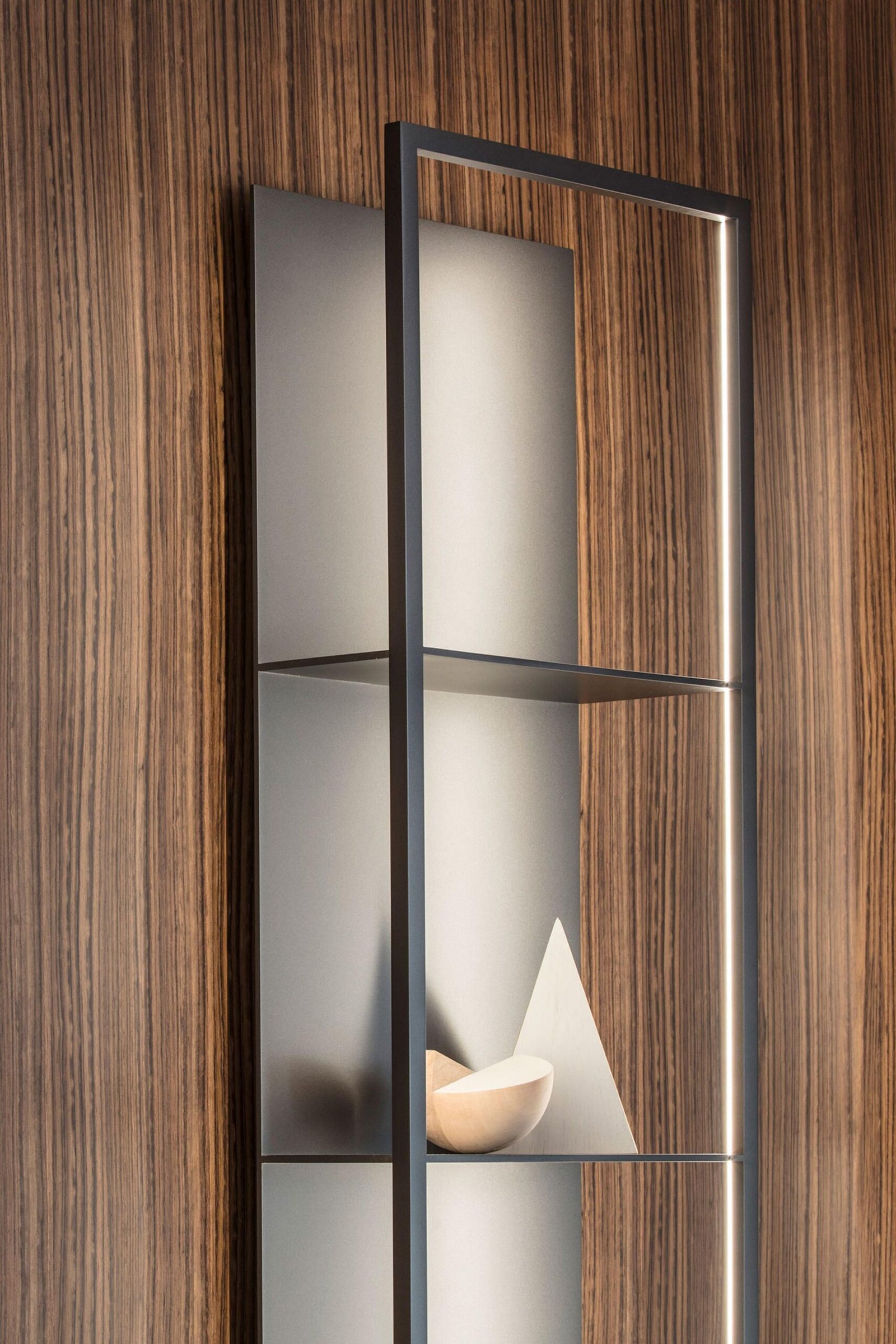
Not every piece of furniture needs to know its place. Some are designed to command the room. A black steel frame, offset wooden shelves, and a silhouette that’s more architectural drawing than domestic furniture — this is one of those pieces.
7. The arched-top bookcase
The arch is one of architecture’s oldest and most emotionally resonant forms. When it appears in furniture, it carries some of that history with it — bringing warmth, softness, and a suggestion of sanctuary to rooms that might otherwise feel sharp or cold.
8. The glass-panel display cabinet
There’s a category of objects in every home that deserve to be seen rather than stored. Ceramics made by artists. Books with spines too beautiful to face inward. Travel pieces that carry memories.
A glass display cabinet frames these things properly — the way a gallery frames a painting. Clean. Protected. Completely intentional.
Building the Built-In Illusion
9. The floor-to-ceiling freestanding bookcase
Custom built-in shelving is the most coveted upgrade in residential interiors. It is also, for most budgets, completely impractical.
The workaround is elegant in its simplicity: a tall, frameless freestanding bookcase placed flush to the wall, painted the wall’s own color. The boundary dissolves. The built-in illusion holds. Almost no one spots the difference.
10. Two bookcases flanking a fireplace
Symmetry is one of the oldest organizing principles in architecture because it works. Two matched bookcases on either side of a fireplace create the kind of composed, balanced focal wall that rooms are designed to contain.
It transforms a living room wall into something that feels built, considered, and genuinely architectural.
11. The illuminated alcove bookcase
Light and space are co-conspirators in the best interiors. A bookcase fitted into an alcove and lined with a concealed LED strip above brings together both: storage, atmosphere, and a corner that finally earns its place in the room.
Small-Space Strategies That Punch Above Their Weight
12. The corner bookcase
Most corners are architectural leftovers — spaces that exist because walls meet at 90 degrees and no one thought about what to put there. A corner bookcase addresses this directly, wrapping around the junction and making something useful of a space that was previously nothing at all.
13. The behind-sofa bookcase shelf
The zone between the back of the sofa and the wall has always been a quiet design problem. Too narrow for another piece of furniture. Too wide to ignore. A low horizontal bookcase resolves it completely — providing a display surface on top, storage for baskets within, and a clean visual line that ties the sofa to the room.
14. The face-out display bookshelf
Turn the books forward. Let the covers do what covers are designed to do. Each book becomes a small flat composition — a piece of graphic art mounted on a very shallow shelf.
This works in places where most shelves can’t fit: a corridor, a bathroom, the wall beside a bed.
15. The under-stair bookcase
Under the stairs is a space defined by constraints: low at one end, narrow along most of its run, triangular in cross-section. A bookcase designed for that form doesn’t fight those constraints. It works with them. The result looks like the house was always meant to have it.
Designs That Announce Themselves
16. The tonal dark bookcase on a dark wall
The counterintuitive move: a dark bookcase against a wall painted in the same dark tone. The first instinct is that everything will disappear. The actual result is that everything comes forward.
The monochromatic depth makes the objects on the shelves float. The room reads as intentional, controlled, and quietly confident.
17. The sculptural biomorphic bookcase
Some furniture exists to serve a function. Some furniture exists to ask a question. A curved, organic-form bookcase is unambiguously in the second category — a piece that makes people stop and consider it, the way they would a sculpture encountered unexpectedly in a room.
18. The rotating 360-degree bookcase
Movement in furniture is rare, which is why it registers so strongly. A bookcase that rotates is both functionally superior and visually arresting in a way that static alternatives simply cannot replicate.
19. The color-blocked bookcase
Painting individual shelf compartments in distinct colors transforms a standard bookcase into a graphic composition. The result belongs to a tradition that stretches from Mondrian to mid-century graphic design — applied, here, to a piece of furniture for a weekend and a modest investment.
Bookcase Ideas for Every Room in the House
20. The kitchen bookcase
The kitchen is where most of daily life actually happens. It’s also the room most likely to be treated as purely functional. A slim open bookcase — holding cookbooks, ceramics, and trailing foliage — brings personality to a room that genuinely earns it.
21. The bookcase headboard
Replace the headboard and both nightstands with a single low, wide bookcase running behind the bed. Books, a reading lamp, everything you reach for at night — organized and contained in something that actually looks designed, rather than assembled from three separate purchases.
22. The bathroom ladder shelf
A ladder shelf in the bathroom is unexpected. That unexpectedness is its entire value proposition: it signals that someone thought about this room beyond its function, and that signal is almost always welcome.
23. The entryway bookcase
Everything a guest concludes about your home in those first few seconds — before they’ve seen anything else — comes from the entry. A slim entryway bookcase, carefully styled, sets a tone that carries through every room that follows.
The Art of Styling Shelves
You’ve chosen the bookcase. It’s in the room. Now the question is what to put on it.
Most people approach shelf styling intuitively. The result is usually too full or too empty. Here are two principles that produce something better:
24. The rule of three as a compositional foundation
Three objects per cluster. A stack of books, a plant, a ceramic piece. Each object at a different height. The visual triangle implicit in that arrangement is the most naturally pleasing compositional unit available to shelf design. Use it on every shelf.
25. Bidirectional book arrangements
Upright books on one shelf. Horizontal stacks on the next. Alternated consistently across the unit.
The horizontal stacks become small platforms. Objects placed on top of them add a third dimension to the composition. The overall effect is a bookcase that reads as designed rather than merely organized — a distinction that makes all the difference.
The Scale Imperative
One thing overrides every other consideration: scale.
A bookcase that fits the room dimensionally but not proportionally fails its purpose. Too small for the wall and it looks tentative. Too large for the room and it dominates in the wrong way.
The right proportion: the bookcase should occupy roughly two-thirds of the available wall width. When a smaller unit is deliberately chosen, it should be balanced with additional visual weight — art, a mirror, a floor lamp — to complete the composition.
Scale right, and everything else resolves. Scale wrong, and no amount of careful styling compensates.
Begin
Twenty-five ideas. One room. One wall. One decision.
The right bookcase for your space is somewhere in the list above. You’ll know it when you find it — it’s the idea that makes you stop and think: that’s what’s been missing.
Trust that instinct. Measure the wall. Make the choice. Style it with care.
The room you’ve been trying to finish is closer than you think.
The next step is yours.