
Disclosure : This post may contain affiliate links or paid partnerships. I may earn compensation if you click a link or make a purchase, at no additional cost to you. See my disclosure for more info.
You don’t need new chairs.
You just need to use the ones you have differently.
This is the thing most home design content never says out loud. It is almost always easier — and significantly cheaper — to transform what you have than to replace it.
The chairs in your living room right now have more potential than they’re currently expressing. Not because they’re bad chairs necessarily, but because the decisions around them — how they’re positioned, what they’re styled with, how they relate to everything else — were probably never fully thought through.
These twenty-seven tips are about extracting the design value that’s already inside your existing space.
Some of them will cost you nothing.
Some will cost ten to twenty dollars.
Very few require a single new piece of furniture.
All of them can make a visible difference this weekend.
Shape and Scale: Fixes That Cost Nothing
1. Before buying anything, measure what you have and where it sits.
Get a tape measure out. Document the actual dimensions of every chair and the actual dimensions of the space around them.
You may discover that a chair you thought was fine is actually occupying space in a way that’s contracting the room. Or you may confirm that scale isn’t the problem. Either answer is useful. You can’t solve a problem you haven’t measured.
2. Identify whether the room is missing one curved form.
Look at your room as if for the first time. Are all the chairs angular and boxy? If so, the room is visually tense without anyone knowing why.
A rounded or barrel-back chair introduced into that arrangement softens everything around it. You may only need to swap one piece.
3. Consider whether any existing chair could be swapped for a lower profile option.
If you’re in a room with a standard ceiling that feels low, one of your chairs might be the reason.
Replacing a high-backed chair with a lower, more horizontal form increases the perceived gap between furniture and ceiling — and the room breathes.
4. Move your existing chairs to expose more floor.
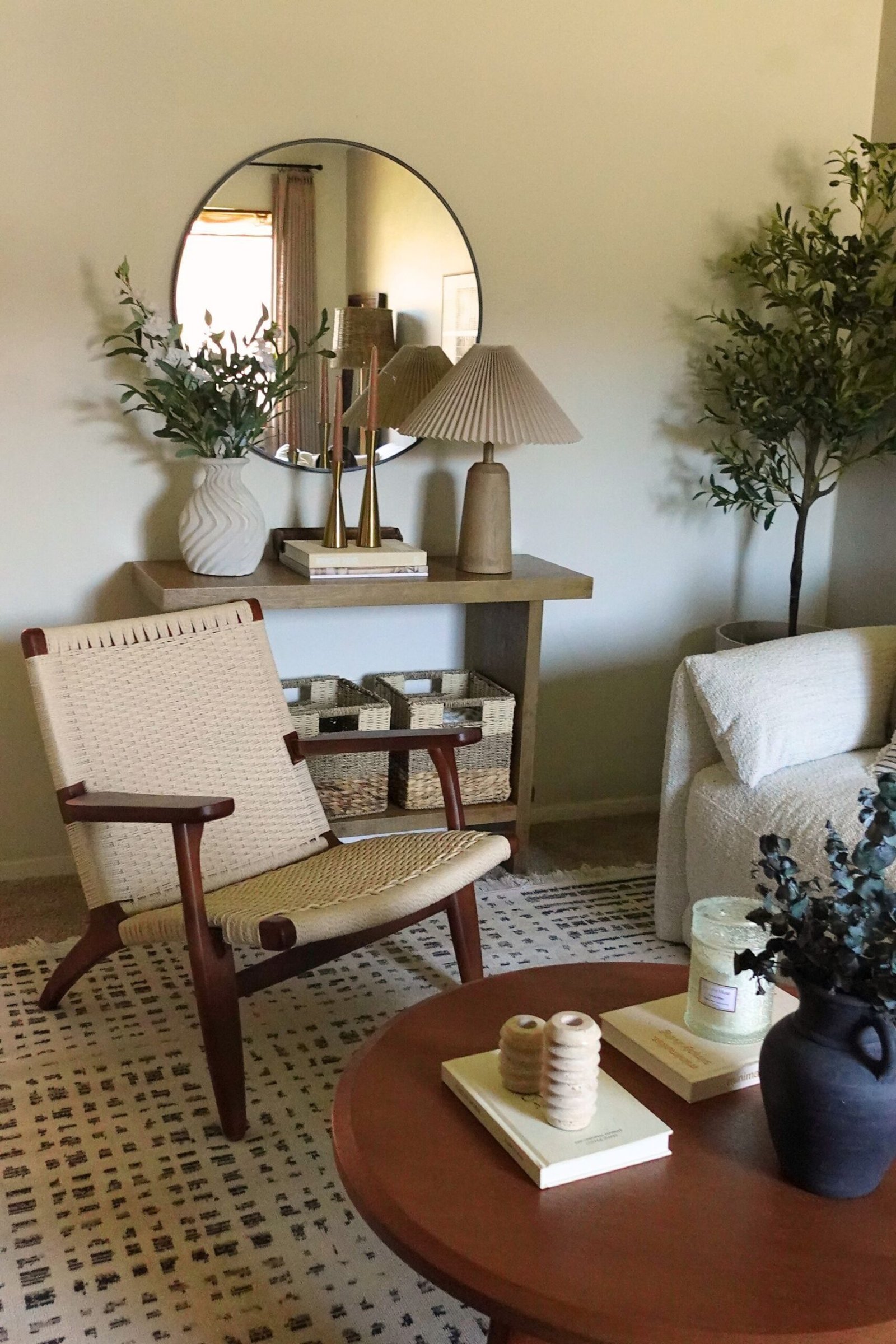
Some of the chairs in your living room may be positioned so that their bases or surrounding objects block the floor from view.
Clear around each one. Make sure the leg structure is visible. Visible floor equals perceived space. This is a free adjustment available to you right now.
5. Consider whether one existing chair could serve as a bolder anchor.
Often one chair in the room is larger or more substantial than the others — but it’s been placed in a secondary position out of habit or indecision.
Move that chair to the primary position. Let it anchor the arrangement. What reads as the “main” chair in the room shapes everything else around it.
Color and Material: Transformations Under Thirty Dollars
6. Break up a monochromatic seating arrangement with contrast.
If everything in your seating group is the same tone — all gray, all beige, all the same neutral — the room is flat. Not bad. Just flat.
If you can’t reupholster, look at what you can place on or around the chairs to introduce contrast. A throw, a pillow, a slipcover can shift the color relationship without a single upholstered purchase.
7. Add a textured throw to any chair that feels visually plain.
A chunky knit, a woven cotton, a faux-fur square.
A throw draped over one arm of a plain chair adds surface texture and visual richness for under thirty dollars. The chair looks styled immediately. This is the highest-return transformation on this list per dollar spent.
8. Look into slipcovers as a performance-fabric upgrade for existing chairs.
If your existing upholstery is stained, worn, or simply the wrong color, a well-made slipcover in a performance or durable fabric can effectively recloth the chair.
Modern slipcovers fit more precisely than the loose-fitting versions of previous decades. Some are difficult to distinguish from direct upholstery. Worth researching before replacing the whole piece.
9. Style one existing chair in the room’s boldest color.
Using your existing chairs, which one could absorb a strong accent color most effectively?
A solid-covered lumbar pillow in terracotta, sapphire, or deep green placed on the right neutral chair makes it the room’s focal piece. No reupholstering required.
10. If you’re buying one new chair, make it leather.
If there’s room in the budget for one new piece, a leather armchair in a warm tone will do more for the room’s sense of quality and permanence than an equivalently priced fabric piece. Leather reads as investment. It develops character rather than showing wear. One leather piece makes the whole room feel more considered.
11. Walk around your existing floating chairs and look at the backs.
Do this right now. Walk around each chair that sits away from the wall.
If the backs are plain and uninspired, note it. When you next purchase a replacement chair — even years from now — prioritize a beautiful back. Until then, positioning matters: a chair with a poor back should sit near a wall where the back isn’t the first thing you see.
Placement: Free Transformations Available Immediately
12. Pull every chair in your living room away from the walls. Right now.
Go do this before finishing this article.
Every chair. Pull each one eight to twelve inches forward. Step back and look at the room from the doorway.
This single free adjustment will visibly improve most living rooms. It creates a zone. It creates intention. It creates the difference between furniture stored in a room and furniture arranged for a room.
13. Angle your accent chairs toward the conversation center.
After pulling the chairs forward, rotate each accent seat to face roughly thirty to forty-five degrees toward the main sofa or seating axis.
Look at the room again from the doorway. There is now a conversation geometry. The room has a center. That center is where the room’s social life will happen.
14. Find the best corner in your living room and dedicate it to one chair.
Move your most comfortable chair into a corner. Add a small table and a floor lamp. That’s your reading nook now.
This is a free transformation that adds an entire zone to your living room without any new furniture. It also makes the rest of the room feel more intentional by contrast.
15. Try flanking your fireplace with two matching or similar chairs.
If you have two comparable chairs and a fireplace, put the chairs on either side of it.
Step back. Look at it. The fireplace will seem to have gained architectural significance overnight. This is symmetry working as intended. It costs nothing and takes about five minutes to try.
16. Reposition one chair to mark the edge of your living zone.
In an open-plan space, take one chair and move it to the outer boundary of the seating group. Not away from the group — at its edge.
This creates a clear perimeter. The room suddenly has a defined beginning and end. Both the living area and whatever is adjacent to it feel more complete.
17. Find where the afternoon light falls and put your best chair there.
You already know the best spots in your living room. The corner with the garden view. The window seat with the good afternoon light.
Move your most comfortable chair to that spot. The improvement in how the room feels — and how often that chair gets used — will be immediate and ongoing.
Upgrades for Under Twenty Dollars
18. Replace the legs on any chair that looks budget despite being serviceable.
This tip has an almost absurdly high return on investment.
Generic chairs with standard legs broadcast their price point through those legs more than any other feature. Remove the existing legs — usually screwed on. Install walnut tapers, brass-capped alternatives, or matte black metal replacements. The chair looks like it belongs in a room that cost much more than yours currently suggests. Budget: under twenty dollars.
19. Add one lumbar pillow to each accent chair in a contrasting material.
One lumbar pillow per chair. Different material from the chair. Velvet on linen. Woven on smooth. Stripe on solid.
The contrast adds a layer of considered styling to each chair. It communicates that someone styled these pieces intentionally. That’s the distinction between furniture that was bought and furniture that was designed.
20. Look at your current chairs for any hidden craft details you haven’t noticed.
Nail-heads you’ve been ignoring. An exposed wood frame partially hidden by positioning. Joinery detail visible only from certain angles.
Make sure your arrangement highlights these features rather than obscuring them. Good chairs often have craft elements that get buried by bad positioning.
21. Evaluate whether any existing chair has a silhouette worth showcasing.
If one of your chairs has an interesting form — a curved back, a distinctive frame, a sculptural shape — is it currently positioned to show that silhouette?
Moving a chair with a great profile so it’s seen in profile turns an overlooked piece into a room’s character piece. No purchase necessary.
Functional Improvements That Change How the Room Gets Used
22. Test whether any existing chair could accept a swivel base.
Some chairs can be retrofitted with a swivel mechanism. It’s worth checking — the behavioral difference in a multipurpose room is significant.
If not, note it as a priority feature for the next chair purchase in the space. Swivel is a functional upgrade that changes how the room actually gets used — not just how it looks.
23. Pair your best chair with an ottoman you already own.
Look around your home. Is there an ottoman sitting in another room, or at the foot of a bed, or doing nothing in particular?
Bring it into the living room and pair it with your accent chair. The combination immediately signals relaxation. The chair goes from a seat to a destination. The room becomes somewhere people want to stay.
24. Drape a throw over one arm before your next guests arrive.
The throw you already own. The chair you already own. Three seconds of your time.
A casually draped throw changes how the chair reads from across the room. Warm. Used. Styled. Inviting. This is the cheapest visible improvement on this entire list.
Avoiding the Mistakes That Undo Everything Else
25. Remove any chair from the living room that nobody actually sits in.
If a chair in your living room is essentially a decorative object — good-looking, never occupied — consider moving it out of the primary seating arrangement.
A chair that’s never used makes the room feel like a showroom. A room that’s used is better than a room that’s displayed. Move the uncomfortable chair to an entry, a bedroom, or a study. Let the living room be for living.
26. Sit in each existing chair and honestly assess the seat depth.
Some of the chairs you currently own may be consistently uncomfortable because of seat depth rather than cushion quality.
If sitting all the way back leaves your feet off the floor, the chair is too deep for your body. Adding a lumbar pillow is the free fix. Acknowledging that it may need replacing eventually is the honest assessment.
27. Rotate your chairs with the changing seasons.
You don’t need to buy anything for this.
In spring, move the heavier, darker chairs to a secondary position and bring forward lighter, more open-structured pieces. In autumn, reverse it. Pull the velvet forward when the temperature drops. Move the rattan or woven pieces to prominence when it rises.
The room stays seasonally alive. It never stagnates. It never stops being noticed.
The Room You Have Is Already Enough
Here’s what these twenty-seven tips are pointing at:
Most living rooms don’t need more furniture. They need better decisions about the furniture already in them.
The chair you bought two years ago and forgot to think about. The placement that defaulted to the walls and never got reconsidered. The throw sitting unused on a shelf in another room.
Start there. Start with what you have.
Pull one chair off the wall. Angle it toward the conversation. Drape that throw over the arm. Replace the legs if they’re generic.
One change. This weekend. Then another next weekend.
The room you want is already inside the room you have. The chairs are where you unlock it.