
Disclosure : This post may contain affiliate links or paid partnerships. I may earn compensation if you click a link or make a purchase, at no additional cost to you. See my disclosure for more info.
The kitchens that hold up — the ones that still feel right a decade after they were put together — share something in common.
They were built around real materials rather than trend references. Wood. Stone. Iron. Linen. Things that develop character with age rather than showing their age.
The farmhouse kitchen, at its best, is an argument for this approach. Function made visible. Materials used honestly. Warmth built from the ground up.
Here are over 30 ways to apply that principle to your own kitchen.
Natural Fibres First: Textiles as the Room’s Foundation Layer
1. Hang undyed or lightly bleached linen at the windows.
Natural linen linen curtains are among the best window treatments for a farmhouse kitchen because they behave like natural fibres always do — unpretentiously. They wrinkle. They move. They filter light with an organic quality that synthetic fabrics never replicate.
2. Put a natural-fibre runner on the kitchen floor.
A vintage-style runner rug in a faded, muted pattern adds the warmth of textile to a space dominated by hard materials. It’s also one of the room’s most ergonomic upgrades — standing on a rug is just better than standing on stone or tile.
3. Replace disposable napkins with woven cotton or linen cloth.
Keep cloth ones in a basket on the counter. This is a shift from disposable to durable that touches every meal, quietly elevating its character. It also pairs well with the basket — both serving the same honest, made-to-last design language.
Honest Objects: The Small Things That Communicate Big Values
4. Add a plant — one that’s actually alive and useful.
A rosemary on the windowsill. A basil near the cutting board. A single living, useful plant communicates the farmhouse kitchen’s core value: that things here serve a purpose. Decorative is best when it’s also functional.
5. Display real wooden cutting boards against the backsplash.
A mix of shapes and hardwoods. Cutting boards are the farmhouse kitchen’s most honest decor element — objects whose beauty derives entirely from their material quality and the fact that they are constantly in use.
6. Store the trash out of sight.
A concealed bin in a pull-out cabinet removes a purely functional object from the room’s visual field. What you don’t see can’t compete with what you’ve carefully chosen to display.
7. Leave the cast iron out in the open.
A cast iron skillet on the stove is the kitchen’s most honest material object. Iron, seasoned with use, patinated with time — it embodies everything the farmhouse aesthetic values: durability, materiality, and evidence of a well-used life.
8. Find a wooden step stool and give it a permanent corner.
Solid wood, simple construction, long-lasting. A wooden step stool is a farmhouse object by definition — practical, beautiful in its utility, made from a material that doesn’t lie about what it is.
Built to Last: The Material Choices That Shape the Kitchen’s Identity
9. Choose a fireclay or cast iron apron-front sink.
A deep apron-front farmhouse sink is the kitchen’s primary material statement. Fireclay and cast iron are materials that improve with time — they develop character, they resist trends, and they carry the unspoken authority of objects made to outlast everything around them.
10. Paint the cabinets in a white that reads warm, not sterile.
The difference between cream and cool white is everything in a farmhouse kitchen. Warm white — the color of aged paper, well-worn canvas — communicates age and care. Cool white communicates renovation. They are not interchangeable.
11. Use solid wood butcher block as the primary counter material, or at least one significant section.
Maple. Walnut. A material that takes a knife mark with grace and becomes more beautiful for it. Stone is permanent and cold. Wood is permanent and warm. In a farmhouse kitchen, warmth wins.
12. Panel the island in beadboard.
The vertical stripe of beadboard is a material memory of old painted wood — farmhouses, porches, old kitchens built for working. It adds texture and reference simultaneously, which is what the best architectural details do.
13. Choose handmade-feeling ceramic or a non-standard color for the subway tile backsplash.
The shape references tradition. A personal color — sage, bone, slate, old blue — gives the backsplash character. Perfectly regular commercial white subway tile can feel right; handmade variations or a chosen color feel better.
The Island’s Role: Centrepiece, Workstation, and Social Hub
14. Source an island with furniture-quality joinery and presence.
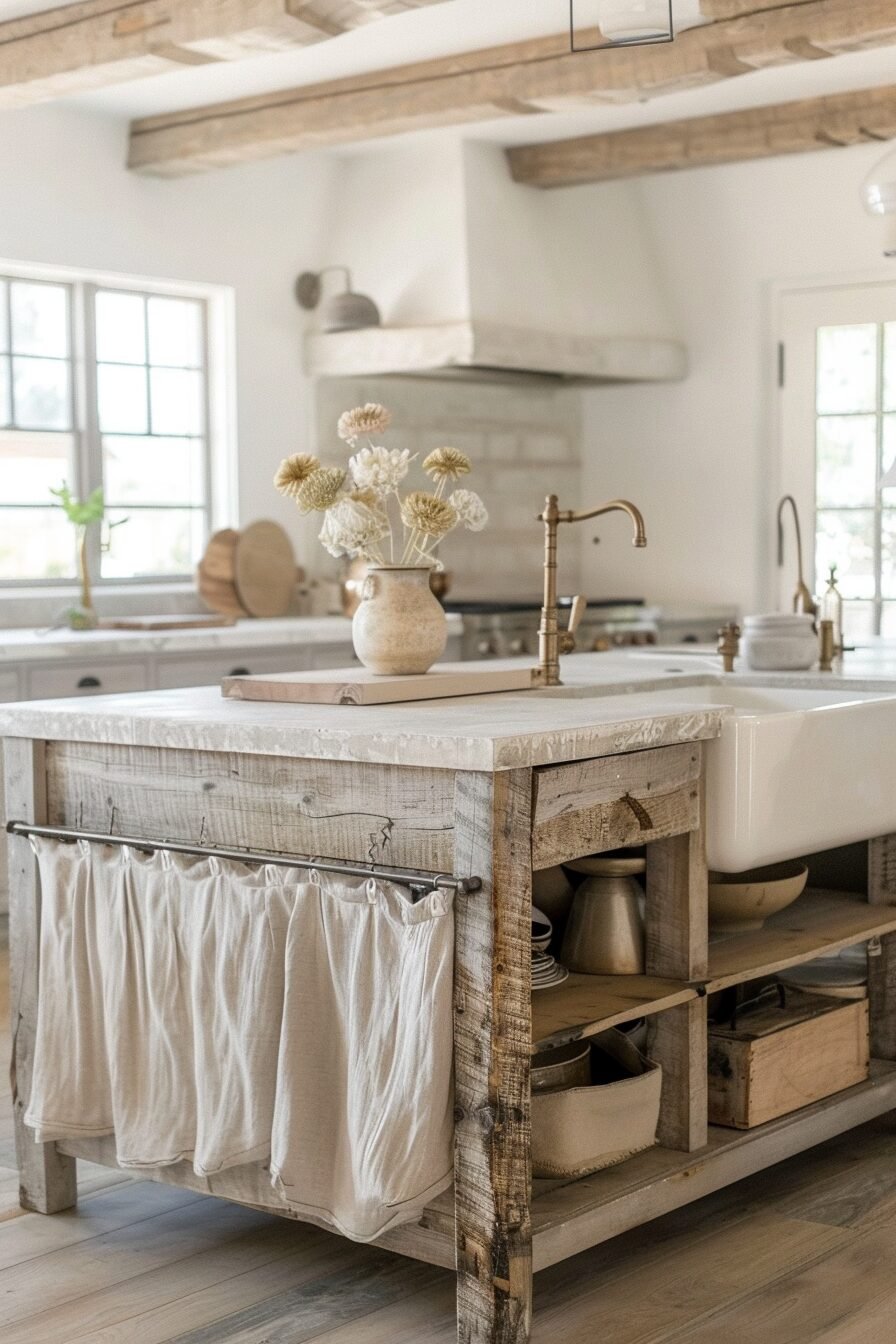
Turned legs. Solid wood. A finish that has depth. A furniture-style island in this tradition looks like it was made to be there — not manufactured to fill a space. The difference in how a room feels with one versus the other is significant and immediate.
15. Keep the island surface stocked with working objects.
A cutting board resting against the splash. A stoneware crock of wooden tools. A folded linen. These are objects that prove the island works hard. A surface loaded with functional things is more beautiful than one that’s staged to look clean.
16. Pull up mixed seating.
Wood stools of different origins. Seats that developed individually rather than arrived together. The visual dialogue between mismatched objects is exactly what gives a room the feeling of having been lived in over time.
The Details That Reveal a Kitchen’s Character: Hardware, Light, and Fixtures
17. Fit the cabinets with iron or bronze hardware that has weight.
Bin pulls. Bin pulls. Cup pulls. Objects with thickness and visual mass. Hardware is the room’s tactile detail — the part of the kitchen you touch most often, which means it deserves to be made of something that rewards the hand.
18. Choose a pendant light made of real industrial material.
Iron. Steel. A metal pendant light in a matte, unfinished, or deliberately aged treatment. Farmhouse lighting shouldn’t look designed — it should look sourced, functional, and honestly made.
19. Replace the faucet with a bridge-style model in a period-appropriate finish.
A bridge-style model references the functional plumbing of an older era — the kind where the mechanics were visible and honest about what they were doing. In a kitchen built around material honesty, that quality in the faucet fits exactly.
20. Screw iron hooks under the upper cabinets.
For mugs, towels, and tools. Iron is honest: it doesn’t pretend to be something it’s not, it doesn’t corrode quickly, and it looks exactly right against painted wood cabinets in a farmhouse kitchen. Material authenticity in every detail adds up.
Storage With Texture: Organization as a Material Statement
21. Display ceramic dishes on a wall-mounted rack.
Real ironstone. Hand-thrown stoneware. The ceramics you use daily are almost certainly made from honest materials that look better displayed than stored behind a door. A plate rack makes this argument simply and effectively.
22. Use woven natural-fibre baskets for counter organization.
Seagrass, rattan, wicker — whatever the weave, a woven basket brings the same natural material language to storage that butcher block and linen bring to counters and windows. Consistency of material reference is what makes a room feel considered.
23. Hang cookware on a wooden pegboard.
Cast iron. Copper. Carbon steel. The cookware materials that belong in a farmhouse kitchen are exactly the kind that look good on display. A painted wooden pegboard is the only fitting backdrop for them.
24. Decant dry goods into glass.
Clear glass jars with simple labels. Glass is an honest material — it doesn’t hide what’s inside it. The pantry shelf becomes transparent and considered, which is the farmhouse approach to storage taken to its natural conclusion.
Walls and Ceilings: Applying Material Honesty to the Room’s Architecture
25. Open up the upper cabinet section to display shelving.
Solid wood Open shelves, brackets of iron or wood. The material of the shelf becomes part of the display — which is correct. In a farmhouse kitchen, structural materials are never something to hide.
26. Apply shiplap — real painted pine boards — to the wall behind the range.
One wall. The texture and material memory of shiplap is inseparable from the farmhouse tradition. Used once and with restraint, it reads as knowing and confident. Used everywhere, it reads as a theme.
27. Add ceiling beams in real or well-crafted faux wood.
Timber overhead is an ancient architectural decision that communicates shelter and craftsmanship. faux beams in reclaimed wood or an honest faux alternative bring that material weight to the room’s highest surface — and change its character completely.
28. Apply board-and-batten panelling to the dining area wall.
White-painted pine, from the floor to chair-rail height. It’s a simple material application with an architectural effect far greater than its cost. It also ages well — which is the point of building with honest materials.
29. Introduce an earthy paint tone to one wall.
Dried sage. Warm terracotta. Faded indigo. Earth pigments in a kitchen with natural materials create resonance rather than contrast — the color acknowledges what everything else is made of.
The Dining End: Where Material and Community Converge
30. Build a corner bench in solid wood with upholstered seat cushions.
Real wood. Durable fabric. A table made of honest materials pulled close. This is the farmhouse kitchen at its most functional and most social — a place built from materials that age well and uses that get better with time.
31. Hang a cast iron or enamel clock on the dining area wall.
Old materials. A round enamel wall clock face that tells time without fuss or ornament. This is the farmhouse aesthetic in three dimensions: a functional object made of real material, placed where it will be seen and used every day for decades.
32. Keep a wooden tray on the table year-round.
Solid wood, as simply made as possible. A wooden tray that holds a candle, some seasonings, and whatever else the table needs. It stays because it’s right — and things that are right tend to stay.
The Long View: A Farmhouse Kitchen Built to Last
The best farmhouse kitchens aren’t designed to look good in photos. They’re designed to work well over time.
That means choosing materials that age gracefully. Objects that earn their place. Details that reward attention rather than demanding it.
This list is not a renovation plan. It’s an inventory of honest choices — each one a small argument for quality over trend, material over finish, and lasting warmth over photogenic flash.
Start with what’s most true to what you already have. Build from there.
The kitchen you’re after is the one that looks better in ten years than it does today. That’s the standard to build toward.