
Disclosure : This post may contain affiliate links or paid partnerships. I may earn compensation if you click a link or make a purchase, at no additional cost to you. See my disclosure for more info.
Can I say something a little uncomfortable?
Your front door is probably holding your home back.
Not the structure. Not the layout. Not the kitchen you’ve been meaning to update or the bathroom that needs a new floor. The door. The most visible, most interaction-heavy, most photographed part of your home’s exterior.
And here’s the thing: fixing it is often far simpler and less expensive than you think.
I’ve put together 43 modern front door ideas covering every approach, every style, and every budget. Some will suit your home perfectly. Some won’t. Trust your instincts and start with what resonates.
Let’s walk through them.
Paint Colors That Will Genuinely Transform Your Entry
Color first. Always color first.
Because nothing — nothing — changes a front door faster or more dramatically than a fresh coat of the right paint. And the right colors are probably not what you think they are.
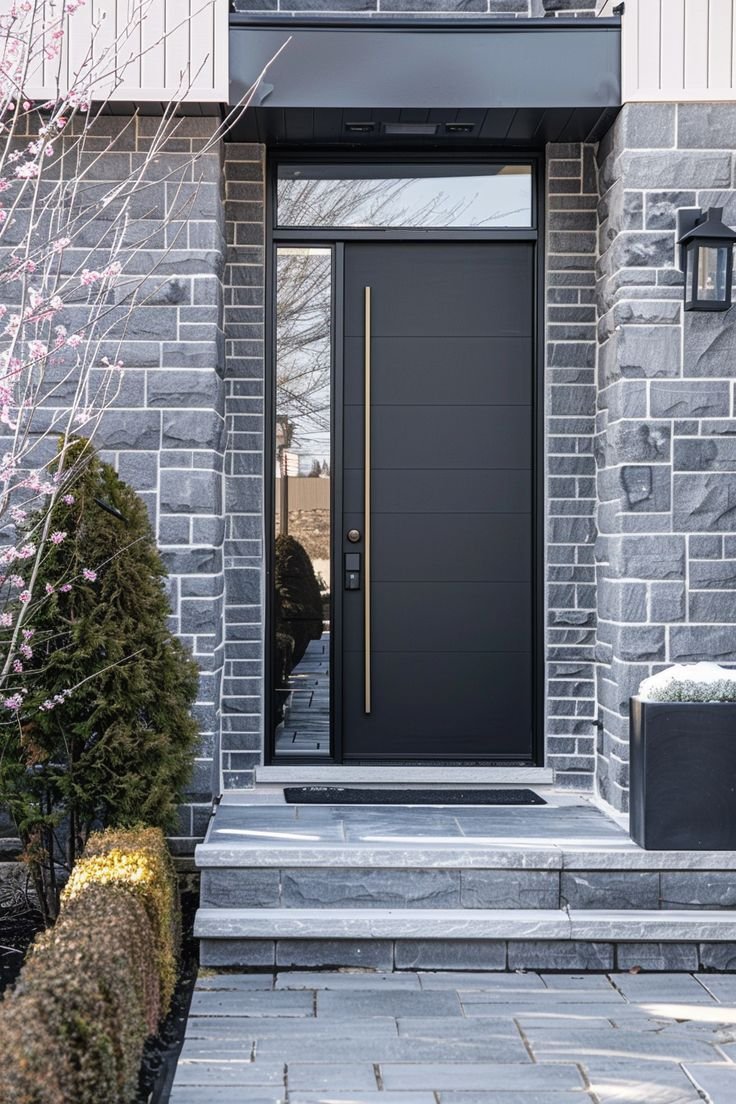
1. Flat black with brass hardware accents. I know you’ve seen this everywhere. There’s a reason for that. The combination simply works, in a way that transcends trends and looks equally at home on a farmhouse or a contemporary build.
2. Terracotta or spiced clay. This one surprises people. It sounds like it might be too much. On the right exterior — white, cream, or soft grey siding — it’s actually one of the most sophisticated choices available.
3. Dark forest green. Ask any interior designer for a front door color recommendation right now and there’s a reasonable chance they say some version of this. It has a depth and naturalness that works on almost every exterior material.
4. Ink blue or midnight navy. If you want a color that reads as permanent, quality, and intentional without veering into territory that might feel trendy in five years, navy is your answer.
5. Sage or silver-green. The most contemporary of the green family. Neither as bold as forest green nor as safe as grey-green, sage occupies a register that feels genuinely current.
6. Warm dark grey or charcoal. When pure black feels too definitive for your exterior, charcoal provides the same visual weight with more warmth and flexibility.
Here’s what to do: buy a small tin of your top two choices. Paint a generous swatch on the actual door. Come back and look at it in the morning when the light is cool, in the afternoon when it’s warm, and in the evening when it’s low. Then make your decision. This process will save you a repaint.
Pivot Doors: The Entry That Changes How You Come Home
Pivot doors are an investment. They’re not the right choice for everyone, and I want to be straight about that from the start.
But they deliver something no standard door can: a feeling of genuine arrival. The slow, balanced rotation of a well-made pivot door turns walking into your home from a transaction into an experience.
If that matters to you — and for some people it really does — then it’s worth understanding your options.
7. Tall solid timber pivot. The combination of height, mass, and natural material creates an entry presence that is hard to overstate. These doors feel like the beginning of something.
8. Slender steel and glass pivot. For the home that wants transparency and light, a thin steel frame with floor-to-ceiling glazing delivers drama and brightness in equal measure.
9. Aluminum frame with obscure glass sidelight. A more practical expression of the pivot format. The aluminum frame handles weather beautifully. The obscure glass gives you privacy. The pivot mechanism gives you the entry experience you’re after.
If pivot doors are appealing but the cost feels prohibitive, worth noting: entry doors are one of the few home improvements with a high return at resale because of their visibility and impact. Budget realistically, get multiple quotes, and think of it as a long-term investment in how you experience your home daily.
Using Glass to Fix Your Dark Foyer
A dark hallway immediately inside the front door is one of the most common and most solvable problems in residential design. If your entry feels dim, oppressive, or unwelcoming, your door is likely the issue — not the light fixtures.
Here’s how glass can help.
10. Full-lite glass door with a slim frame. The most impactful option for entries that aren’t directly exposed to foot traffic. The foyer transforms from a cave to a room filled with natural light that moves and changes through the day.
11. Frosted or obscure glass panel door. A workable middle ground: meaningful light transmission with maintained privacy. The texture of the glass becomes a design feature in its own right.
12. Adding sidelights to your existing door. The simplest and most cost-effective glass option. You don’t replace the door — you add narrow glass panels beside it. The change in the light quality of your hallway is typically immediate and significant.
13. Transom window above the door frame. High-level natural light is the warmest and most even kind. A generous transom is an architectural detail that’s been delivering this benefit for centuries.
14. Reeded or ribbed glass insert. If you want a glass treatment that is also a design statement, reeded glass is the current frontrunner. It diffracts light beautifully and looks genuinely considered.
Glass and privacy: check your entry from the outside at night with your interior lights on. Many glass treatments that feel private during the day become transparent after dark. If your entry is visible from the street or neighbours, specify obscure glass or accept that your foyer will be on display in the evenings.
Wood Doors That Feel 2024, Not 1994
The wood front door gets unfairly maligned. The association with heavy stained oak and dated panel styles has soured people on a material that, in contemporary form, is genuinely extraordinary.
Here’s what modern wood doors actually look like.
15. Vertical-grained white oak. Pale, directional, and architecturally refined. When properly sealed, white oak ages beautifully rather than looking tired.
16. Solid walnut slab door. Dark tones, rich grain variation, and a natural beauty that no paint or composite can replicate. Walnut is arguably the most visually sophisticated choice for a front door.
17. Teak with horizontal detailing. The bands add surface interest without decorative excess. Teak’s inherent resistance to moisture and UV makes it one of the most practical premium door materials.
18. Scandinavian-inspired maple. Clean grain. Light tone. Minimal character. For homes that favor a northern European approach to design, maple hits exactly the right note.
19. Reclaimed hardwood in a modern profile. The beauty of this option is unique in a literal sense: no other door will look exactly like yours. The history embedded in reclaimed timber creates a surface that is irreproducible by any other means.
Talk to your door supplier about timber species performance in your specific climate before committing. A door that looks exceptional in a showroom can deteriorate quickly in conditions it wasn’t designed for. Match the material to the environment and the maintenance schedule you can realistically commit to.
Hardware Upgrades: The Affordable Game-Changer
This is where I want to spend a moment with you.
Because if you take one thing from this entire list, it might be this: you can upgrade how your front door looks and feels substantially, today, for a few hundred dollars or less.
The lever. The pull bar. The numbers. The hinges. These details add up to something that, when done thoughtfully, makes people ask whether you got a new door.
20. Slim matte black lever handle. Replace your existing knob in under half an hour. The difference is immediately visible and the cost is minimal.
21. Vertical bar pull in brushed brass. This piece above everything else transforms a door. The longer and thinner the pull, the more architectural and intentional it reads.
22. Contemporary smart lock system. The combination of function (no keys, phone-accessible) and form (many newer models have a genuinely low profile) makes this a worthwhile upgrade for most homes.
23. Large, well-chosen house numbers. In a contemporary typeface. Large enough to read from the footpath. Most people’s numbers are too small and too timid. Be bolder.
24. A built-in mail slot. If you want the cleanest possible exterior face on your door, an integrated letter plate is the solution.
And please: match your hinge finish to the rest of your hardware. Inconsistency here undermines everything you’ve done to make the entry feel considered.
Hardware is the highest-ROI change on this list. Period. Do this first, even before you repaint. Because once you’ve seen what the right hardware does to your existing door, you’ll know whether you actually need a new door at all.
Double Doors: When One Simply Isn’t Enough
There’s an architecture to welcoming people into a home. Double doors are one of the most effective physical expressions of that architecture.
They say: this home is not minimizing. It is opening itself to you.
25. Glazed steel French doors. Light, graphic, and a genuine design statement in either direction. The thin steel frame creates a visual clarity that heavier materials can’t achieve.
26. Double timber pivot configuration. The most impressive residential entry format. Demanding in terms of installation and cost. Exceptional in terms of result.
27. Arched double with fluted glass panels. The arch is an ancient architectural form that’s been used for good reason — it works. Combined with contemporary fluted glass, it creates an entry that is both timeless and current.
28. Asymmetric double leaf configuration. A wider primary leaf and a narrower secondary leaf. Contemporary in feel. Practical in use. Visually unexpected.
If you’re considering retrofitting double doors, get a structural assessment before ordering. Widening an opening is not the same as widening a door frame — it involves the lintel and structure above, and that work needs to be specified and done properly.
Minimalist Doors: The Entry That Earns Attention by Not Demanding It
There’s a particular kind of confidence in a minimalist entry. It doesn’t try to impress. It impresses anyway.
29. Perfectly flush, frameless door. The door sits exactly level with the facade. No frame, no reveal, no visible joint. Just a door-shaped section of wall that opens. When it’s executed well, it’s remarkable.
30. Push-plate entry. There is no lever. No pull. A small, flat plate is the only hardware element on the entire door surface. You push to enter, pull to exit. Radical in its simplicity.
31. Door and facade in the same finish. The door disappears into the wall and the entry becomes a moment discovered rather than announced. For homes with strong architectural geometry, this is very powerful.
32. Solid door with a single vertical light. One carefully considered strip of glass in an otherwise uninterrupted door face. The geometry of it — the proportion of glass to solid — is the design decision.
33. Concrete-texture composite door panel. For homes where the architecture uses raw or industrial materials, a door that matches that material vocabulary completes the composition.
Minimalism is the hardest approach to execute and one of the most satisfying when it works. If the context is right — contemporary architecture, strong proportions, precise detailing — go for it.
Mid-Century Doors: Designs That Were Never Really in the Past
Mid-century modern design’s endurance is not a trend. It’s recognition that certain design principles are genuinely good — good enough to remain relevant across generations and stylistic cycles.
34. Geometric panel inlays. The bold graphic language of mid-century design — diamonds, rectangles, starbursts — applied to a door panel remains visually dynamic decades later.
35. Bold paint color with period-appropriate knocker. An era that chose avocado, harvest gold, and flame orange without apology. On the right home, that confidence is still the right choice.
36. Vertical V-groove plank in teal. Teal is to mid-century doors what brass is to contemporary kitchen hardware. It defines the era. With appropriate address numbers, it’s classically correct.
37. Three-light square panel door. Three equal squares, vertically stacked. Symmetrical. Resolved. A design that looked modern in 1958 and continues to look modern now.
If you live in a home built in the post-war decades, working with the architectural language of the period is almost always the right decision. These homes were designed as complete compositions. Respect that.
Entry Surrounds: The Setting That Completes the Statement
You can have the most considered door in the neighborhood and have it undermined by an unresolved entry surround. The door and its immediate context are a single design problem.
38. Vertical panel cladding as an entry feature. Taking vertical panel detailing around the door frame creates a clear, composed entry zone that draws the eye from the street.
39. Natural stone or large-format tile surround. A material change creates depth and weight that painted surfaces cannot. Stone reads as permanent and considered.
40. Strongly contrasting trim color. On a pale facade, a dark surround and architrave is the fastest intervention for giving the entry visual definition and presence.
41. Integrated planting recesses. Greenery that has been designed into the entry rather than added to it creates a composed, finished quality.
42. A set-back entry with curated lighting. The recessed entry creates a threshold space. A well-chosen pendant or downlight in that space turns the entry into something genuinely atmospheric after dark.
43. The right entrance mat. Large enough to be generous. Simple enough not to compete. This is the detail that finishes an entry that has been considered from the curb to the threshold.
Now: What Are You Actually Going to Do?
You’ve read 43 ideas. Now comes the part most design articles skip.
What are you actually going to do? And when?
Not “when things settle down.” Not “when we have a bit more budget.” This season. One thing.
Identify the single highest-impact change for your specific entry. If it’s color, buy the paint this week. If it’s hardware, measure and order this weekend. If it’s a full door replacement, get your first quote before the end of the month.
The entry you want to come home to every day is achievable. But only if you actually take the step.
Go make it happen.