
Disclosure : This post may contain affiliate links or paid partnerships. I may earn compensation if you click a link or make a purchase, at no additional cost to you. See my disclosure for more info.
There is a reason Scandinavian living rooms have become the global benchmark for residential comfort.
They solve a problem that most interior styles don’t even acknowledge: how to make a room feel simultaneously beautiful and genuinely restful. Not one or the other. Both.
The solution isn’t complex. But it requires understanding the principles beneath the aesthetic and applying them deliberately.
These 33 ideas give you both — the principle and the application.
The Furniture Hierarchy
Furniture selection in a Scandinavian room is governed by two criteria: purposefulness and material honesty. Everything else is secondary.
1. Anchor the room with a low-profile sofa in natural upholstery.
Horizontal proportions. Tapered solid wood legs. Removable linen or cotton covers that tolerate regular washing. The Nordic sofa is conceived as the room’s structural baseline — its role is to support, not to steal focus.
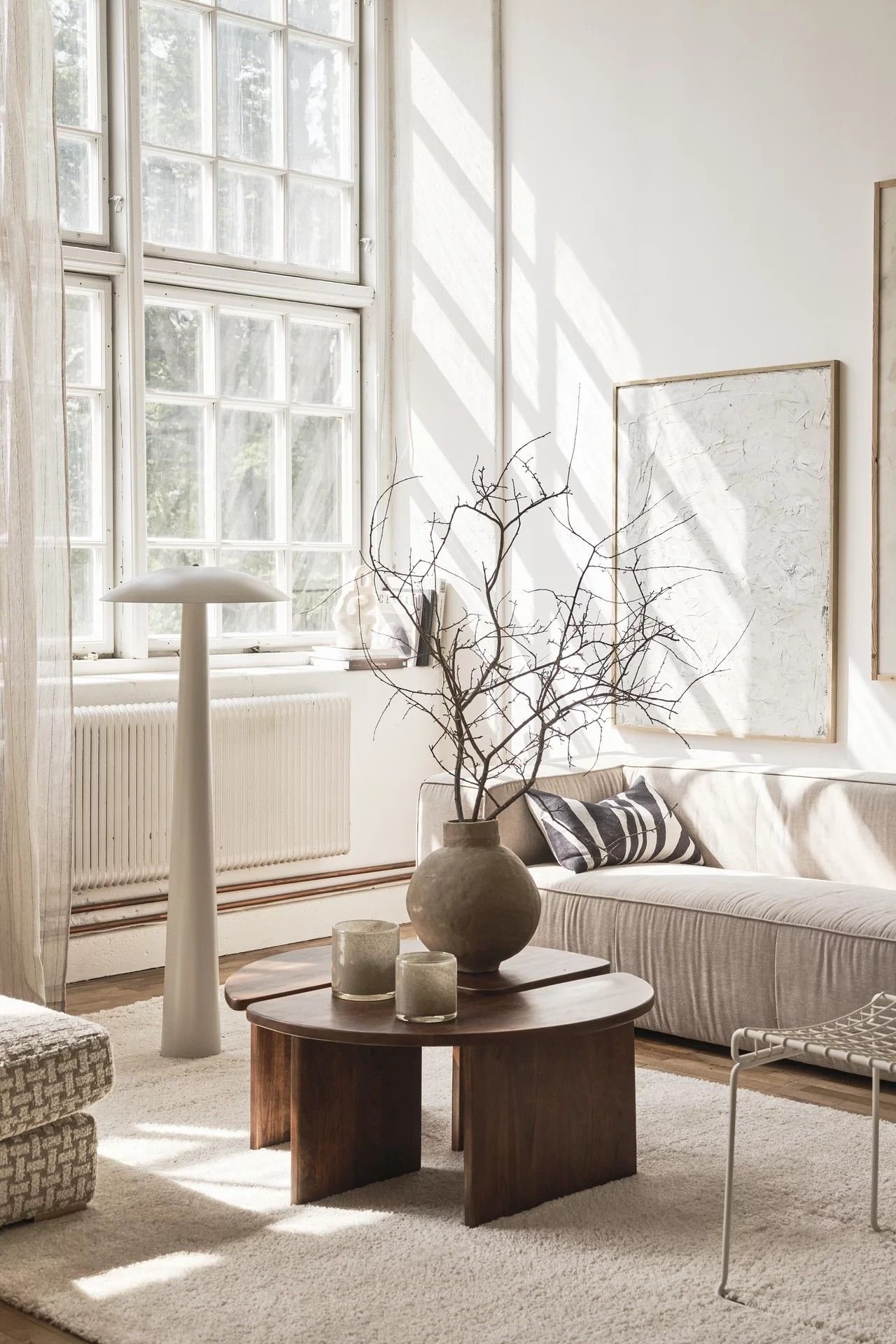
2. Position a hardwood coffee table at the room’s center of gravity.
The grain matters. The finish matters. A light natural oil that lets the wood breathe is correct; thick lacquer sealing it off from touch is not. Knots, grain variation, and color changes are features — not flaws to be concealed.
3. Position one well-chosen accent chair as the room’s focal point.
Mid-century proportions, structured upholstery in boucé or textured wool, solid wood legs. One chair, not two. The singular form has an authority that the paired form gives up immediately.
4. Replace enclosed storage furniture with open-frame shelving.
Slim metal or pale wood frames, wall-mounted, sparingly populated. The visible wall behind the objects is compositionally active. Overpopulating the shelves defeats their entire purpose.
5. Take the media unit off the floor entirely.
A wall-mounted media console in pale wood frees the floor plane and raises the apparent ceiling. The perceptual effect on the room’s scale is significant — far more than the cost of the swap would suggest.
6. Require dual functionality from all upholstered and case goods.
A bench that conceals storage. A stool that functions as a surface. Nordic living spaces assume that beauty and practicality are not competing values but complementary ones.
Palette Construction for Nordic Interiors
The Nordic palette is not “white minimalism.” It is a carefully constructed sequence of warm neutrals, grounding mid-tones, and restrained accent colors.
7. Establish the base layer in warm-biased whites.
Test all whites in natural light. The undertone must lean warm — yellow or pink, never blue. Cold whites read as clinical in most residential contexts. Warm whites read as shelter.
8. Build the secondary layer in greige.
A feature wall or primary sofa in the gray-beige blend gives the palette gravity without introducing visual weight that would compromise the sense of spaciousness. Greige is the workhorse of the Nordic palette — everything else negotiates with it.
9. Introduce tertiary accent colors from the muted earth spectrum.
Desaturated terracotta, sage, dusty rose, warm clay. These colors appear in accessories only, never in primary furnishings. Their role is to provide biological warmth — the suggestion of living organisms within the palette.
10. Apply black as a spatial organizer.
A matte black lamp, a dark-framed mirror, a charcoal cushion. Black creates definition and visual resolution. Limit its application to three locations — beyond that, it ceases to organize and begins to dominate.
11. Respond to palette flatness with material variation, not additional hues.
Raw wood. Nubby linen. Woven natural fiber. When the palette begins to feel monotonous, the correct intervention is sensory, not chromatic. Complexity through texture, not color.
Biophilic Integration: Nature as Structure
Nordic design’s relationship with nature is not decorative. It is structural. Natural elements are placed in the room with the same intention as furniture.
12. Source one large-format specimen plant and position it architecturally.
Fiddle leaf fig, monstera, or snake plant in a woven seagrass basket. Positioned in a corner or at a window where it can develop full scale. One significant plant contributes more to the room’s atmosphere than any collection of smaller specimens.
13. Install dried eucalyptus in a slender ceramic vase.
Three benefits from one object: months of visual presence, subtle natural fragrance, and the signaling of intentional spatial curation. High return for minimal investment.
14. Incorporate objects of natural origin with material authenticity.
Smooth stones. Weathered driftwood. A hand-turned acacia bowl. Objects formed by geological or artisanal processes carry a material authority that manufactured accessories fundamentally cannot replicate.
15. Use a round hardwood tray to organize coffee table surfaces.
Candle, plant, book — contained within the tray’s boundary. The tray functions as a frame: it transforms a collection of objects into a unified compositional unit.
The Nordic Lighting System
Nordic lighting design is one of the most sophisticated aspects of the aesthetic — and the one most often misunderstood as simply “more candles.”
16. Establish the primary ambient fixture with a sculptural pendant of organic character.
Woven rattan, paper, or frosted glass in a form that suggests natural growth or craft. This fixture sets the room’s emotional temperature. It is the first lighting decision and the most consequential.
17. Layer secondary light sources at human scale from at least two directions.
Floor lamps in corners. Table lamps on side surfaces. Sconces on walls. The Nordic lighting system creates warmth by distributing it — no single source should do all the work.
18. Integrate candlelight as a consistent element of the evening environment.
Multiple candles grouped on a tray, lit each evening as a matter of routine rather than occasion. Candlelight in Nordic homes is functional, not ceremonial. It is expected, not special.
19. Treat natural light as the primary architectural resource of the space.
Remove heavy window treatments. Retain at most the lightest sheer linen panels for privacy. The movement of natural light across surfaces throughout the day is irreplaceable as a design element.
Wall Composition and Artwork
Wall decisions in a Nordic living room are made with the same deliberateness as furniture decisions.
20. Select one oversized artwork scaled correctly for the wall.
Abstract, photographic, or minimalist. The piece should occupy enough wall area to command attention without requiring competition. Properly scaled art reads as confident; undersized art reads as cautious.
21. Apply limewash or microcement to one accent wall.
The resulting texture catches and diffuses light differently throughout the day. It introduces depth and dimension that flat paint cannot produce and that no wallcovering fully replicates.
22. Install slim timber picture ledges for flexible art presentation.
Prints leaned against the wall surface. Rotated seasonally. No additional fixings required. The ledge system supports the Nordic principle that interiors should evolve rather than be completed.
Accessory Curation: Principles and Practice
Nordic rooms are defined as much by what they exclude as by what they include.
23. Begin any room update with hardware and fixture replacement.
New drawer and cabinet hardware in brushed brass or matte black. A replaced overhead fixture. The investment-to-impact ratio of this intervention is higher than almost any other option available.
24. Curate the coffee table book selection to a maximum of three volumes.
Selected for cover design and subject relevance. Arranged intentionally. The books are part of the composition; they are not overflow from a shelf.
25. Mount a minimal round wall clock in wood or matte black.
A clean round face with legible numerals. The correct clock for a Nordic room is the one that becomes part of the room’s background. If it draws attention to itself, it’s the wrong clock.
26. Incorporate a firewood element as both functional and decorative.
A slim black metal log rack stacked with birch. Whether operational or purely visual, it introduces the tactile vocabulary of fire, warmth, and craft into the room.
27. Establish a reading zone using four elements.
Chair, floor lamp, sheepskin throw, and a small selection of books. The reading nook is a zone of use, not of display. Its completion is functional, not aesthetic.
28. Apply the one-in-one-out rule to all decorative acquisitions.
One piece added, one piece removed. This discipline maintains the spatial economy that defines Nordic rooms — not as an annual edit, but as an ongoing practice.
29. Layer scent using natural soy candles or wood-based reed diffusers.
Cedar, pine, bergamot. Olfactory experience precedes visual experience when entering a space. The scent of a room establishes its character before any design element is consciously perceived.
Textile Specification for Nordic Interiors
Textile selection governs the room’s tactile register. It determines whether the room is pleasant to be near or genuinely inviting to inhabit.
30. Position a chunky woven throw on the sofa without formal arrangement.
Draped informally at one end. Slightly rumpled. The casually placed throw signals use and life — exactly the qualities that hygge requires.
31. Drape a sheepskin or quality faux fur over the accent chair, falling naturally.
The drape should be organic — gravity-driven rather than styled. The chair transforms from a piece of furniture into the most sought-after seat in the room.
32. Recover sofa cushions in linen fabric in a cohesive tonal palette.
Four to five cushions in related neutral and earth tones. Linen is specified for its aging properties: it softens with washing, develops character, and resists the artificial precision of synthetic materials that make rooms feel too finished.
33. Define the seating zone with an oversized flat-weave rug in natural fiber.
Jute, wool, or a cotton blend. Neutral color. Scaled so that front sofa legs at minimum sit fully on the rug surface. An undersized rug undermines the seating zone’s coherence. Err consistently toward larger.
The Methodological Principle: Restraint Over Time
The most common execution failure in Scandinavian interior design is not a wrong color choice or a poorly selected piece of furniture.
It is attempting to complete the room in a single session.
Nordic interiors are the product of disciplined restraint applied incrementally over time. Five decisions made well, allowed to settle, evaluated honestly, then extended.
The rooms that exemplify this aesthetic were not assembled over a weekend. They were built through successive small acts of considered addition — and occasional, equally considered, subtraction.
The method is as much part of the result as any individual choice.
Commencing the Work
The room you want to live in does not require an extended budget or external expertise.
It requires a first decision, made today. Then a second. Then a third.
Select one idea from this list. Execute it. Allow the room to respond. Then proceed.
The Nordic living room that has been in your imagination is built exactly this way — one clear, intentional move at a time.