
Disclosure : This post may contain affiliate links or paid partnerships. I may earn compensation if you click a link or make a purchase, at no additional cost to you. See my disclosure for more info.
You close the front door behind you and you are completely depleted.
Everything aches slightly. Your brain is running on fumes. Your phone is still lighting up with things that needed to be done yesterday.
You walk into your bathroom and… it offers nothing.
Not peace. Not even comfort. Just a room that looks the same as it always has, asking nothing and giving nothing.
Here is the thing.
It doesn’t have to be this way. Your bathroom can be designed to actively restore you rather than simply hold your toiletries.
That is not a renovation project. That is a philosophy. Specifically, it is the philosophy embedded in Japanese bathroom design for over a thousand years.
And you can apply it starting today.
Here are twenty-eight ways.
What Japanese Bathroom Design Actually Prioritizes
Understanding the “why” makes everything else easier to apply.
In Japanese culture, bathing is understood as a form of daily restoration — for the mind as much as the body. The bathroom is designed to support that act, not just facilitate it.
The result is a room that communicates safety, stillness, and space from the moment you enter.
You can create that effect in any bathroom. These twenty-eight ideas show you how.
Getting the Fundamentals Right
1. Separate your wet and dry zones physically
Japanese homes have always kept the bathing space and the changing space apart. Moisture belongs in one area. Dry comfort in another.
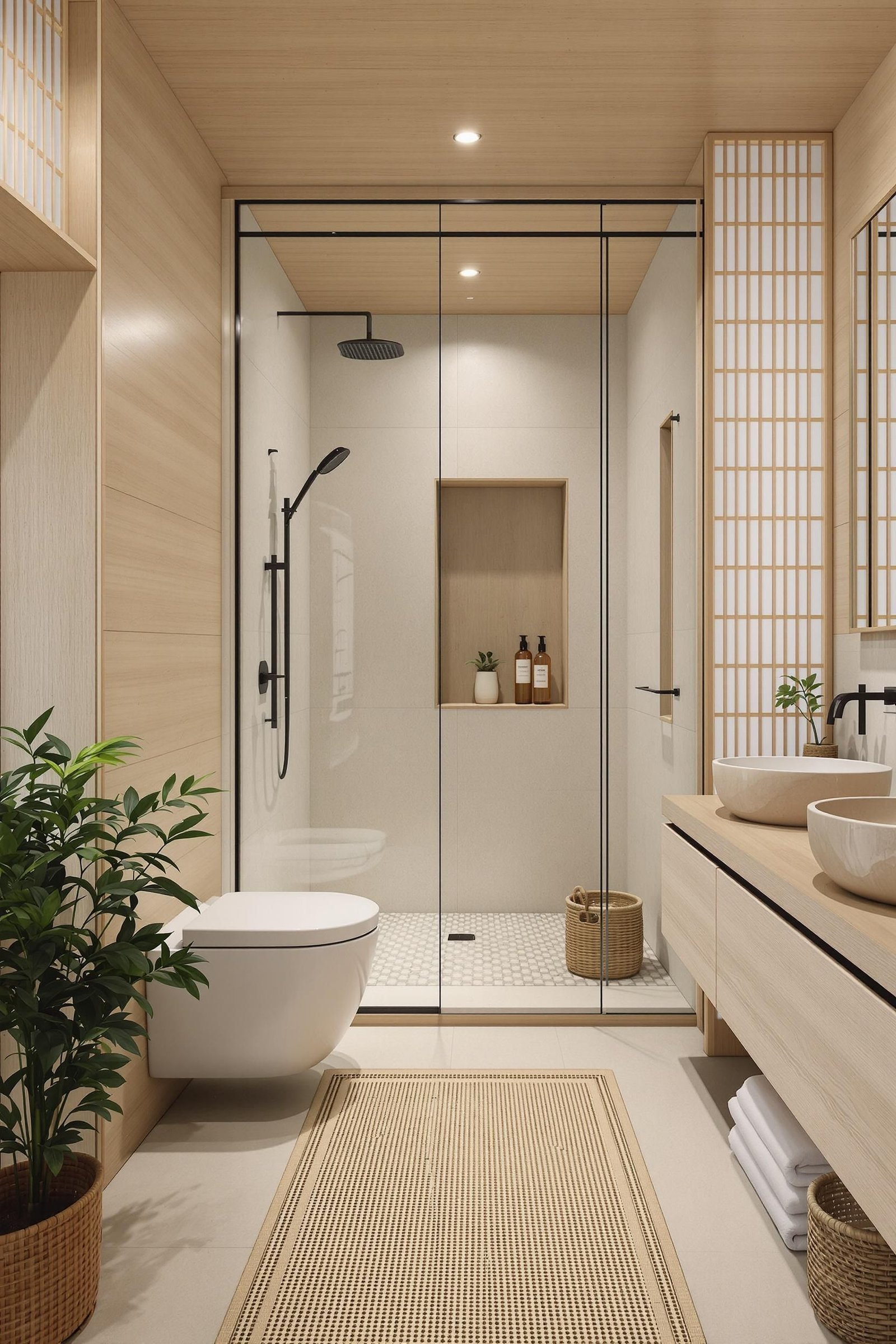
A glass screen or a subtle floor-level step creates this transition. The result is a bathroom that feels more organized, drier, and more intentional.
2. Make the soaking tub the first thing you see
In Japanese design philosophy, the tub is not furniture. It is the purpose of the room. It sits at the center of visual attention.
When you position your soaking tub where it naturally draws the eye, the whole room aligns around it and the space instantly feels more intentional.
3. Build a dedicated pre-soak washing area
In Japan, you rinse yourself completely before entering the soaking tub. The tub is for healing, not cleaning.
A compact station with a handheld showerhead and a low bathing stool makes this approachable in any bathroom. Clean water. Clean ritual.
4. Isolate the toilet from the bathing area
A simple partition or pocket door is enough.
Once the toilet is visually and spatially removed from the bathing zone, the room shifts fundamentally from functional space to personal sanctuary.
Material Selection That Matters
5. Incorporate hinoki cypress into the space
Hinoki is the defining material of Japanese bath culture. Naturally water-resistant. Naturally antibacterial. Built entirely for this environment.
Its signature quality is the scent it releases in steam — a warm, clean, cedar-and-citrus aroma that no manufactured product can authentically reproduce.
A hinoki mat, a bathing stool, or a wooden tray near the tub activates this every time you bathe.
6. Lay natural stone beneath your feet
River pebbles, smooth slate tiles, or polished stone create an earthy, grounding surface underfoot.
A pebbled shower floor connects you to the natural world in a tangible way — and functions as a gentle daily foot massage you didn’t know you needed.
7. Commit to matte finishes on everything
Polished and glossy finishes are energetically busy. They reflect and amplify visual noise.
Matte surfaces absorb light and create a sense of warmth, depth, and quiet. They make a bathroom feel designed for rest rather than display.
8. Add texture to walls with washi-inspired panels
Washi paper has no place in a wet room. But panels that reference its soft, layered, handcrafted character lend warmth and visual interest to the walls without introducing pattern or color.
Subtle and deliberate. Exactly the right balance.
Water: The Essential Element
9. Source a proper ofuro deep soaking tub
This is the keystone of the entire Japanese bathroom experience. Everything else builds around it.
The ofuro is deeper than a standard Western tub and proportioned for upright sitting rather than lying. You are submerged to your shoulders in hot water that envelops you completely.
The experience bears almost no resemblance to a Western bath. A deep soaking tub is not one option among many — it is the defining upgrade.
10. Mount a rain showerhead overhead in the shower zone
A ceiling-mounted rain showerhead delivers water uniformly from above. Wide coverage, gentle pressure, no angle adjustments.
Rinsing off becomes something you genuinely look forward to rather than endure.
11. Add a handheld wand on an adjustable sliding rail
A sliding rail gives you full height control whether you are standing, seated, or anywhere in between.
Practical. And consistent with the Japanese value of thoughtful, intentional bathing.
12. Let a water feature carry the acoustic atmosphere
Flowing water is central to the Japanese sensory environment. The garden. The tea room. The bath hall.
A tabletop fountain beside the tub introduces a layer of sonic calm that is fundamentally different from music or silence. It actively cues the nervous system to rest.
Lighting Done the Japanese Way
13. Trade cool overhead lights for warm, dimmable sources
Bright white lighting is stimulating by design. It is incompatible with restoration.
Warm LED strips positioned behind mirrors or beneath floating vanities, controlled by a dimmer, allow you to match the light to the mood rather than fighting it.
14. Install a backlit mirror for diffused, flattering light
A backlit mirror replaces the glare and shadows of standard vanity lighting with a soft, evenly distributed glow.
The room feels softer and more considered with this one change alone.
15. Introduce lantern warmth or flickering candlelight
Whether it is a Japanese paper lantern-style pendant or a few simple candle holders, flickering warm light sends a powerful physiological message.
Your nervous system interprets flicker as safety. That is not poetic. That is biology.
Minimalism as a Daily Practice
16. Make every surface invisible when not in use
Every product left out is a micro-stressor. In aggregate, they make a room feel exhausting rather than restorative.
Floating vanities with hidden storage, recessed shower niches, and built-in cabinets create a surface-clear environment that signals calm from the moment you enter.
17. Hold to a two- or three-tone color palette
Soft white. Natural stone. Warm timber. Nothing else.
A disciplined palette creates the visual silence that lets a bathroom feel like a place to exhale rather than a room competing for your attention.
It is the simplest design move with the largest impact.
18. Choose one considered decorative object and give it space
A single ceramic object. One artful soap dish. One small stem.
“Ma” — the Japanese concept of meaningful empty space — holds that the air around a single object matters as much as the object itself. What you leave out shapes what you put in.
19. Standardize towels in one color and texture
Colorful or mismatched towels undermine visual calm in any bathroom, no matter how well-designed everything else is.
One neutral shade, one quality of fabric, organized neatly on an open shelf. A minor edit with a major return.
Bringing the Outside In
20. Keep one living plant near the tub
Ferns, pothos, bamboo, or peace lily — each thrives in a bathroom environment and requires almost no maintenance.
A single plant near the water establishes a quiet, living presence. This is “shizen” — the Japanese principle of natural beauty that doesn’t strain to announce itself.
21. Lay a bamboo tray across the soaking tub
A bamboo caddy holding tea, a book, or a candle transforms the act of bathing into a contained, deliberate ritual.
Less about the objects and more about the permission to be fully present they create.
22. Install something visually restful to look at from the tub
A window with frosted glass: natural light without exposure. A frosted window is itself a design element.
No window? A framed landscape image — water, forest, open sky — places something peaceful directly in your line of sight when your body is at rest.
Sensory Details That Seal the Experience
23. Fit a heated towel rack to the wall
A warm towel after a long soak is one of those pleasures that is so consistently good it never loses its effect.
A wall-mounted heated towel rack is affordable, easy to install, and turns every single bath into a moment that feels genuinely indulgent.
24. Hang botanical bundles near the showerhead
Fresh eucalyptus or cedar near the shower releases essential oils in the steam and fills the room with a natural, enveloping fragrance.
No devices. No synthetic products. Plants and heat, working together.
25. Solve the cold floor problem once and for all
Cold tiles underfoot after a warm bath are a daily sensory interruption that undermines the entire experience.
Underfloor radiant heating is the best solution. A well-chosen wooden mat placed strategically is the practical alternative.
26. Actively manage the acoustic environment
A waterproof Bluetooth speaker set to ambient rainfall, traditional Japanese instruments, or clean white noise takes the acoustic dimension of your bathroom from passive to actively restorative.
Most people design their bathrooms entirely visually. Sound is where the real work of relaxation happens.
27. Create a consistent, understated fragrance
Not a commercial air freshener. Not something that dominates the room.
A hinoki chip in a ceramic bowl. One incense stick lit ten minutes before entering. A drop of cedarwood essential oil in warm water.
Japan’s “kodo” tradition sees fragrance as a route to mindful, present-moment awareness — not a decorative add-on.
28. Keep a robe or yukata within arm’s reach
The ritual doesn’t stop when you step out of the water. A deliberate transition matters.
A lightweight cotton or linen robe on a simple wall hook continues the warmth of the soak into the moments after. No break. No cold interruption.
The Only Reason This All Matters
These twenty-eight ideas are not really about bathroom design.
They are about recognizing that your daily recovery is something worth designing around.
A room that actively restores you every day. Where the world’s noise becomes something you can put down for twenty minutes. Where your body actually releases the tension it has been storing since morning.
Japan embedded this understanding into its culture centuries ago. Bathing is medicine. Not metaphorically. Functionally.
And you deserve a room built to deliver it.
Pick one thing. Do it with care. Then pick another.
Every intentional choice compounds. And every one of them is an investment in the version of yourself that exists when the noise stops.
That version deserves a good room.
Go build it.