
Disclosure : This post may contain affiliate links or paid partnerships. I may earn compensation if you click a link or make a purchase, at no additional cost to you. See my disclosure for more info.
There’s a question worth sitting with for a moment.
Why do some bedrooms feel instantly right? Not expensive. Not magazine-perfect. Just… right. Like the room is actually on your side.
You walk in and something settles.
Now think about your bedroom. Does it do that?
If the answer is ‘not really,’ there’s a good chance you’ve been blaming the wrong things. The furniture. The colors. The layout.
The culprit is almost always the lighting — specifically, the absence of intentional ambient light.
What follows are more than 12 specific discoveries about ambient bedroom lighting that will change how you think about the room you spend a third of your life in.
These aren’t abstract theories. They’re practical things you can do today.
Have You Ever Wondered Why Some Bedrooms Just Feel Different?
Walk into a good restaurant and something changes before you’ve even been seated. The tension is already leaving your shoulders — and if you were paying close attention, you’d notice it was the light.
Your brain processes the quality of illumination in real time and translates it into a felt sense of safety, energy, or ease. Warm, soft, layered light communicates: slow down, you’re somewhere good.
Bright, singular, cool overhead light communicates the opposite. It says: stay alert, there’s more to do.
Ambient lighting is the craft of using warm distributed light to tell your nervous system the right story in the right room. In a bedroom, that story should always be: rest is welcome here.
Once you understand that, everything else on this list starts to make complete sense.
1. What Happens When You Finally Stop Relying on One Ceiling Light
Most people replace their overhead bulb with a new overhead bulb and wonder why nothing feels different.
The issue isn’t the bulb. It’s the reliance on a single elevated source to do all the room’s lighting work.
Here’s what actually changes things: distributing light across the room at multiple heights. A bedside lamp near where you sleep. A wall sconce at seated eye level. A floor lamp breathing warmth into a corner.
The overhead fixture is still there. But now it’s one voice in a conversation rather than the only voice in the room. That shift is where atmosphere lives.
2. The Kelvin Number on Your Bulb Box Is More Important Than You Think
Here’s something interesting: most people look at brightness (lumens) and wattage when buying bulbs and completely skip the number that determines how the light actually feels in the room.
That number is the Kelvin rating. It measures color temperature — where the light falls on a spectrum from warm amber to cold blue-white.
For a bedroom that feels warm and restful, you want the 2700K–3000K range. Incandescent warmth. Golden hour. Candlelight.
Above 4000K, light goes blue and cool. It reads as stimulating. Great in some contexts. Wrong in a place meant for rest.
Once you start checking the Kelvin number, you’ll never buy bulbs without it again.
3. What a Single Dimmer Switch Actually Does to a Room
Here’s a thought experiment worth running. Two identical bedrooms — same furniture, same bulbs, same fixtures. The only difference: one has a dimmer switch and one doesn’t.
At 7 in the morning, they look identical. But at 9 at night, one is a calm softly lit retreat. The other is still at full brightness with no way to modulate the mood.
A dimmer gives you the ability to speak the room’s language at the right volume for the right moment. Morning requires a different setting than midnight. One switch handles both.
Hardwired or plug-in. Both versions deliver the same fundamental capability. This is the one change that makes every other lighting improvement work better.
4. The Hotel Lighting Trick You Can Steal for Your Own Headboard
The next time you stay somewhere that feels genuinely luxurious, pay attention to the light behind the bed. It’s almost always indirect — hidden. You can’t see the source, just its warm glow radiating outward.
This is the LED strip technique, and it’s more accessible than it looks.
warm-toned LED lights attached to the rear edge of your headboard, against the wall, bounces output outward as a diffused halo. The source disappears. The effect is what you see.
And that effect is exactly what makes those hotel rooms feel so right. Self-adhesive strips. Plug-in power. About 15 minutes. The result looks professional.
5. Why Salt Lamps Keep Showing Up in Beautiful Bedrooms
People are drawn to Himalayan salt lamps for reasons they often can’t fully articulate. The answer is simple when you know the Kelvin concept.
A Himalayan salt lamp emits light at a naturally ultra-low color temperature — deep amber, deeply warm, physiologically non-stimulating. It’s the kind of light that simply cannot feel harsh. By design.
On a nightstand, it functions as the lowest warmest layer in your lighting composition. A gentle accent that completes the room without competing with anything else.
Now you understand why they keep appearing. They work.
6. The Lampshade Factor Most People Have Never Considered
Here’s a thing most people never think about: the shade and the bulb are two different variables.
You can put a perfect 2700K warm-white bulb in a lamp and still end up with light that feels harsh if the shade is working against it.
White or very translucent shades project light with minimal softening — the output strikes the room rather than wrapping it.
Linen, burlap, and natural woven fabrics scatter and absorb light as it passes through. Everything feels warmer. The bulb didn’t change. The shade did. And the room did too.
7. Recessed Lighting: Where the Difference Between Good and Bad Is Dramatic
Recessed lighting has such a bad reputation in bedrooms that many designers refuse to use it. And they’re not wrong about the usual execution.
Eight cans uniformly spaced across a ceiling, all pointed straight down at full brightness: flat, shadowless, and nothing like a place designed for rest.
But here’s what changes everything: two or three cans on a dimmer, positioned to wash across a textured wall at an angle rather than illuminate a floor from above.
The result is moody warm depth that transforms the room entirely. The contrast between this and the typical approach could not be more dramatic.
8. What Happens When You Light the Inside of Your Shelves
Most people discover this trick and wonder why they waited so long.
Place battery-operated puck lights at the back of open shelves and angle them upward. Light bounces off the back panel and creates a soft gallery-like glow from within the shelf.
What was ordinary storage becomes a lit display. The shelf becomes a feature. The wall becomes warm and alive in a way it simply wasn’t before.
There’s no wiring involved. No holes drilled. No professional installation. The whole change takes about five minutes and produces results that are genuinely striking.
9. Why String Lights Succeed in Some Rooms and Fall Flat in Others
The question with String lights isn’t whether to use them — it’s whether you’re using them with any structure.
Randomly draped across a wall: no structure, no clear line, no framework. Looks improvised.
Run tightly along a ceiling perimeter behind a ledge or molding: structured, clean, architectural. Looks intentional. Or threaded through sheer curtains where the point sources dissolve into a soft luminous wash: diffused, ethereal, genuinely beautiful.
Always warm white. Always minimal-gauge wire. The framework is what makes them work.
10. What a Wall Sconce Can Do That a Bedside Lamp Cannot
A wall sconce with an adjustable arm does something a table lamp cannot: it gets out of the way.
It mounts to the wall. It takes up no surface space. It aims precisely where needed — toward a book, toward a face, toward nothing in particular when ambient mode is preferred.
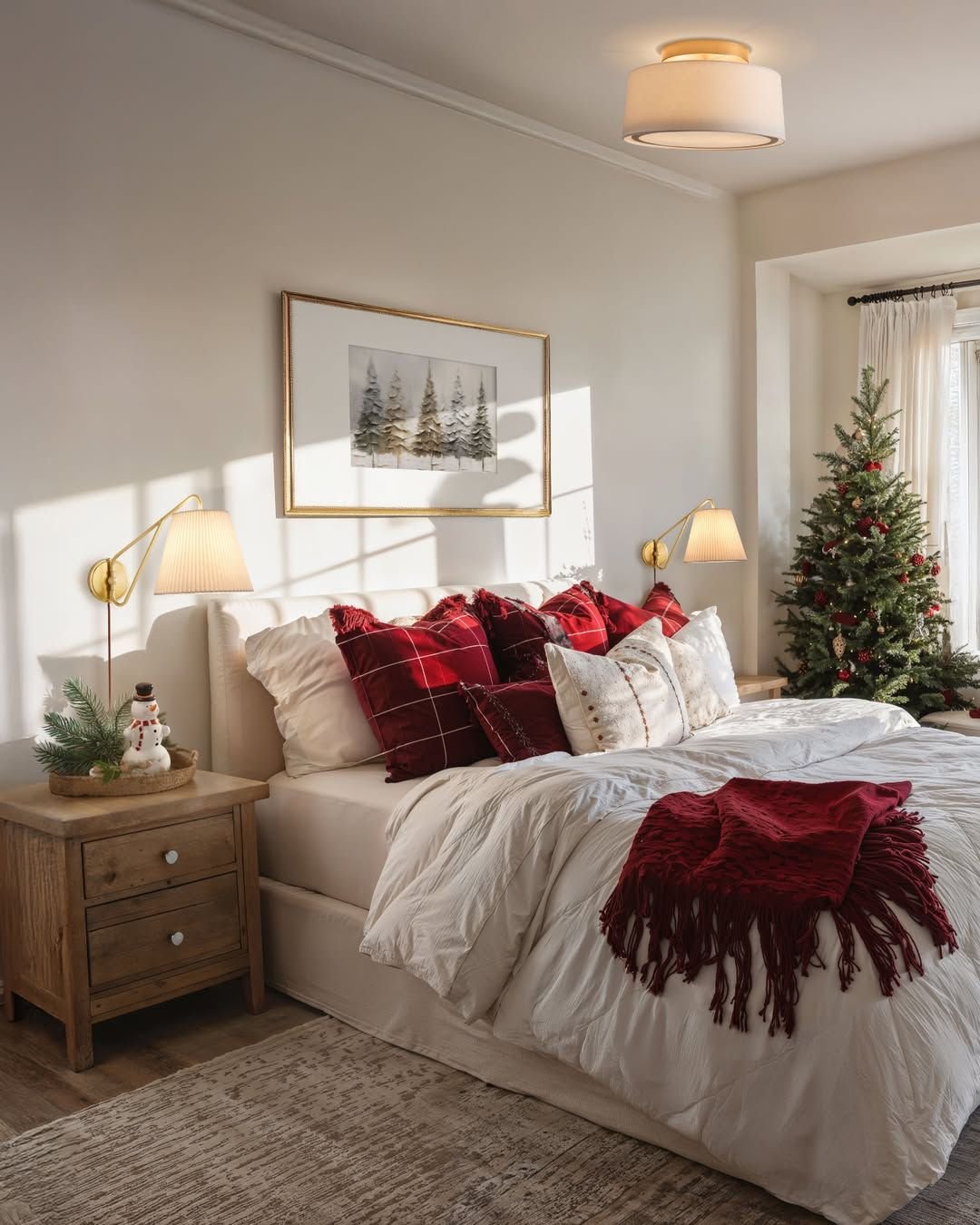
Mounted on both sides of the bed, it replaces the bedside lamps entirely, freeing the nightstands and giving the room a noticeably cleaner more deliberately composed appearance.
Plug-in versions require no electrical work. A warm metallic finish completes the picture.
11. What That Empty Corner Is Actually Doing to Your Whole Room
Unlit corners function as visual voids. They pull the eye and register, subconsciously, as something incomplete or unresolved.
A floor lamp with a fabric shade placed in that corner does three things simultaneously: claims the space so it no longer reads as a void, contributes upward-casting warmth, and makes the room feel more intentionally arranged.
For a corner large enough to accommodate it, an arched floor lamp over a reading chair creates an entirely distinct sub-space within the room. A room-within-the-room effect that is remarkably effective.
12. The Difference Between a Random Candle and an Intentional Arrangement
A single candle on a shelf is decoration. A composed candle arrangement is a lighting decision.
The difference: grouping. Three or five candles at varying heights, collected on a tray, become a unified light source with visual weight and warmth that a single candle simply can’t produce.
Odd numbers feel naturally balanced. Varied heights create visual rhythm. A tray provides containment and intentionality.
If open flame is a concern, flameless LED candles replicate the flicker and warmth with enough accuracy that the distinction becomes hard to notice from across the room.
13. The Light Already in Your Room That You Haven’t Activated Yet
A mirror opposite a light source is doing something you may have never consciously noticed: it’s doubling the apparent output of that source into the zone it faces.
Position a mirror across from a warm lamp rather than an overhead light, and you’ve turned one lamp’s output into two zones of warmth. The room feels brighter and more open without any new fixture.
A large leaning mirror is the most dramatic implementation. A round mirror above a dresser and a mirrored tray contribute smaller but meaningful increments of the same effect.
You’re not adding light. You’re amplifying what’s already there.
14. What Sheer Curtains Reveal About Natural Light
Direct sunlight through clear glass is bright and somewhat harsh, even in late afternoon. The same sunlight through sheer curtains? It becomes the most beautiful natural ambient light you can experience in an interior space.
The translucent fabric disperses the light in every direction before it enters the room, eliminating harshness and producing a warm even glow from floor to ceiling.
Layer the sheers with blackout curtains behind for complete darkness when you sleep. You get the dream light during the day and total darkness at night.
Two layers. One window. Both problems solved.
The Trap That Sends a Good Bedroom Backward
Before you go, there’s one more discovery worth making. It’s not about products or placement.
It’s about the impulse to do everything at once.
Adding five or six new sources in a single weekend almost never produces the warm layered room you’re imagining. It produces a cluttered, overstimulating one where nothing has room to breathe.
Introduce one change. Let it exist in the room for a week. See what it does — how it interacts with the space, how it changes how the room feels to be in. Then add the next layer.
Great ambient lighting is built in dialogue, not monologue.
What One Small Change Tonight Could Feel Like Tomorrow
Here’s the thing about this kind of change: it happens fast.
You don’t have to wait for a renovation. You don’t have to save up for a decorator. You don’t have to understand design theory.
You just have to choose one thing from this list and do it tonight.
Tomorrow morning, you’ll walk into a bedroom that feels slightly different. Slightly more like the room you wanted.
Then come back here. Choose the next one. Keep building.
The bedroom that makes you exhale when you walk in? It’s closer than you think.