
Disclosure : This post may contain affiliate links or paid partnerships. I may earn compensation if you click a link or make a purchase, at no additional cost to you. See my disclosure for more info.
The upgrade your living room needs isn’t bigger. It isn’t more expensive. It isn’t louder.
It’s more intentional.
And the most impactful place to be intentional — the single swap with the highest visual ROI in any living room — is the center table.
Most people know, on some level, that their coffee table is underwhelming. They feel it. That vague dissatisfaction when they walk into their living room and the room doesn’t quite meet them where they want to be met.
The center table is why.
It sits in the middle of the room’s prime visual real estate. Every sitting arrangement faces it. Every conversation happens around it. Every first impression of your living room is partly formed by it.
An uninspired table makes an uninspired room. A well-chosen table makes the same space feel curated, considered, and complete.
Below are 29 coffee table designs that cross that line from ordinary to outstanding. Each one chosen for the specific quality it brings to a living room — not what it costs, not what it looks like in isolation, but what it does to the space around it.
Stone and Marble: Quiet Authority in Material Form
1. White Carrara Marble Round Table
Round form. Carrara surface. Slim metal base.
If you’re uncertain which direction to go, go Carrara. It’s not the safe choice — it’s the reliable one. Reliable because it genuinely works in almost every design context without compromise. The round form means no orientation problems.
One requirement: seal the surface and maintain the discipline of using coasters. Marble is porous and will mark permanently without care.
2. Nero Marquina Black Marble Oval
Jet-black marble, intense white veining, oval shape.
For rooms that have been playing it too safe, this is the intervention. Nero Marquina doesn’t whisper — it speaks clearly. The oval prevents it from becoming aggressive. The result is a room that finally has a focal point worth noticing.
3. Travertine Drum Table
Natural travertine in cylinder form. Earthy, warm, textural.
The drum table is one of the more interesting furniture typologies to emerge from the last decade of design — a pure material object that functions as furniture. The absence of legs makes a room feel more spacious around it.
4. Terrazzo Pedestal Table
Multi-tone stone composite. Polished. Pedestal base.
Terrazzo has an interesting double quality: it’s simultaneously nostalgic (it’s been used in architecture since ancient Rome) and contemporary (it’s having a serious design resurgence right now). That temporal ambiguity is what makes it feel timeless rather than trend-dependent.
Glass Tables: The Counterintuitive Choice That Always Pays Off
5. Tempered Glass on Brushed Gold Base
Clear tempered surface. Geometric brushed gold frame.
Glass tables work because they don’t compete with the rest of the room. They participate without dominating. The brushed gold base ensures the table has visible presence without that presence becoming the room’s loudest statement. Brushed, not polished. The distinction matters.
6. Smoked Glass Oval
Tinted glass oval. Sophisticated and practical in equal measure.
The tint in smoked glass isn’t just aesthetic — it’s functional. Dust and fingerprints that would be visible on clear glass blur into the surface tone. For households that use their living rooms, that practicality is worth taking seriously.
7. Clear Glass Over Walnut Shelf
Transparent top plane over warm walnut storage shelf.
This design is clever about how it solves the styling-versus-using problem: the top surface stays clean because the lower shelf gives the practical objects a dedicated home that’s visible but doesn’t compete with the table’s surface presentation.
Wood Tables: When You Want Something That Improves With Age
8. Live-Edge Walnut Slab
Tree edge preserved. Walnut grain deep and complex. Statement base option.
The live-edge format makes a specific argument about furniture: that individuality matters. Mass production is efficient and reliable. It cannot, however, produce a table that is genuinely one-of-a-kind. Live-edge pieces are, by definition. No two are the same tree, the same edge, the same moment.
9. Japanese-Inspired Low Oak Table
Low profile. Oak. Everything non-essential removed.
Japanese design philosophy in furniture form: remove everything that doesn’t serve a purpose, and then remove a little more. What’s left is something that feels restful and confident rather than sparse or under-designed. For rooms that need to feel like a retreat, this table is exactly right.
10. Dark Stained Pedestal Round Table
Column pedestal. Round top. Dark espresso stain.
Pedestal tables have an inherent architectural quality that legs-on-floor furniture lacks. The column form reads as structural rather than functional, giving the table a presence that extends beyond its surface area. In rooms with traditional architectural details, it’s exactly the right register.
11. Reclaimed Teak Rectangle
Salvaged teak. Visible history. Structural superiority.
Old-growth teak — the kind found in reclaimed pieces — has denser grain, higher natural oil content, and greater durability than plantation-grown alternatives. You’re getting a better material and a more visually interesting surface simultaneously. A genuine win-win.
Metal Tables: Built for Rooms That Want to Make a Statement
12. Hammered Brass Drum
Hand-textured brass cylinder. Visually active at every angle and light condition.
Hammered brass is one of the few materials that gets better under scrutiny rather than worse. The closer you look, the more texture, depth, and variation you find. A table worth looking at closely is a table that earns its space in a room.
13. Blackened Steel and Raw Concrete
Two industrial materials brought into deliberate, refined combination.
This table is not trying to be comfortable or approachable. It’s trying to be honest about its materials and structural logic. In a room softened with textile and organic materials, that honesty becomes a counterpoint that makes both the table and the surrounding softness better.
14. Mirror-Finish Stainless Steel Cube
Polished steel cube. Perfect geometry. The room reflected back at itself.
This is the most conceptually interesting table on the list. It has no inherent visual identity — it borrows identity from everything around it. In a well-designed room, that borrowed identity is amplified and returned. The table becomes a comment on the space rather than simply an object in it.
15. Antique Bronze Sculptural Base
Cast bronze sculptural base. Simple top that deliberately steps back.
Furniture with a clear design hierarchy — one element leads, everything else supports — tends to read as more sophisticated than pieces where everything demands equal attention. The base leads here. Completely. Everything else follows.
Layered and Configurable Tables: Solving the Flexibility Problem
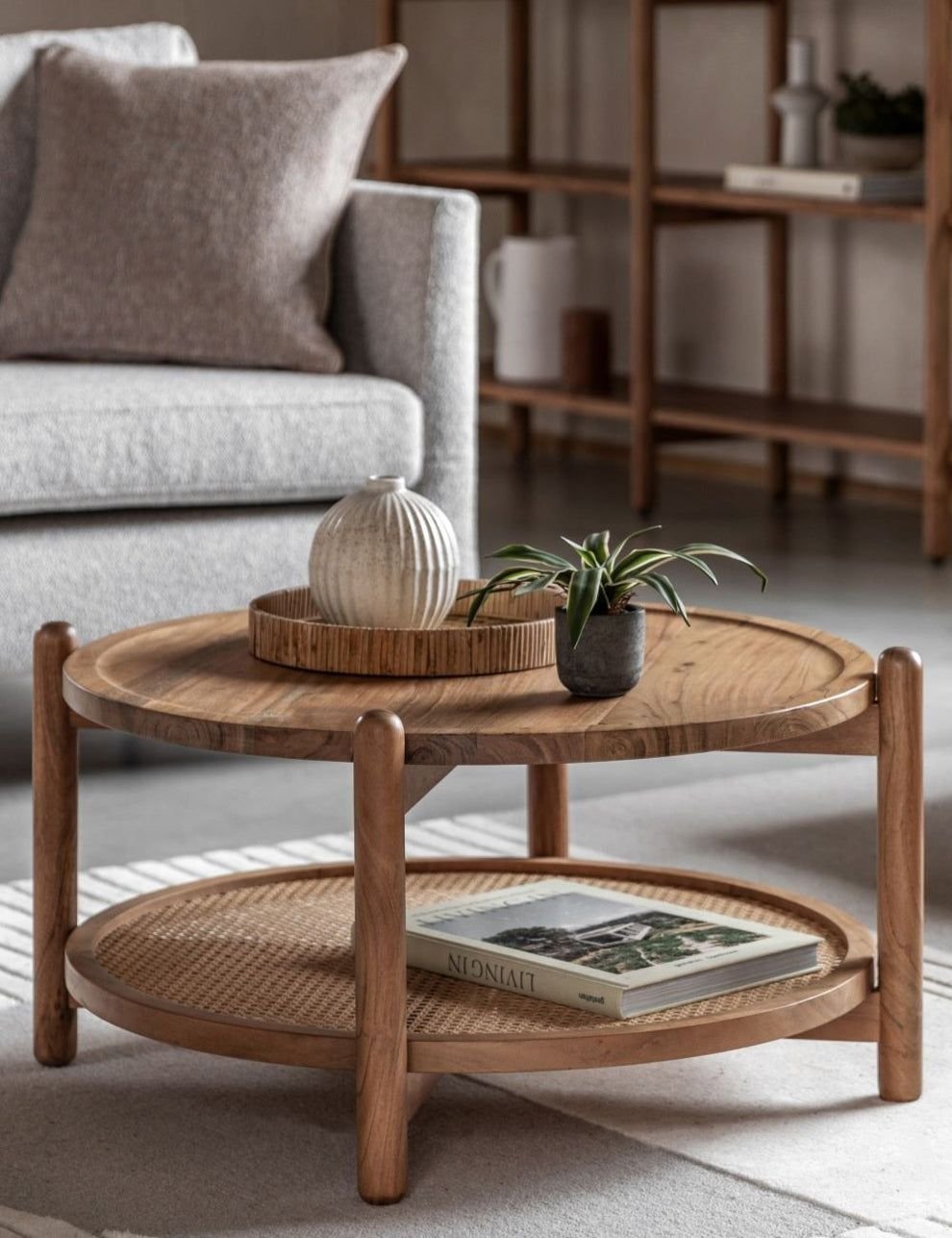
16. Two-Tier Round Table With Open Shelf
Styled top surface. Practical lower shelf. Both tiers integrated into the overall design.
A well-used living room requires surface area for both display and function. This table acknowledges that honestly — it provides both tiers without pretending one doesn’t need to exist. Each tier is designed to look intentional when used properly.
17. Nesting Table Set
Two or three tables that nest or separate as needed. Configurable to the moment.
Flexibility and elegance are often treated as opposites in furniture design. This set refuses that opposition. In its compact configuration it reads as a single refined object. Expanded, it provides a surface system that serves any gathering without aesthetic compromise.
18. Tiered Glass and Marble
Glass upper surface. Marble lower tier. Two materials, two heights, one conversation.
The material pairing here is not arbitrary — glass and marble are both hard, both premium, both cold to the touch, but completely different in opacity and reflectivity. The contrast creates interest that a single-material, single-height table cannot generate.
Sculptural Tables: Art That Happens to Also Be Furniture
19. Freeform Resin Table
Cast resin in unique organic forms. No two alike. Clear or pigmented.
Resin furniture has matured considerably — early pieces were fragile and prone to yellowing, but contemporary furniture-grade resin is durable, UV-stable, and genuinely sculptural. The form possibilities are unlimited in a way that stone, metal, and wood simply aren’t.
20. Glazed Ceramic Hourglass
Monolithic ceramic in hourglass silhouette. Deep saturated matte glaze.
Ceramic furniture’s appeal comes from its honest materiality — it is what it appears to be, made the way it appears to have been made. There’s no structural subtext, no veneered surface, no engineered core. Clay, water, heat. The simplicity reads as integrity.
21. Faceted Geometric Hardwood
Hardwood cut into gem-like facets. Shadows shift continuously with light.
Most furniture looks the same on Tuesday as it did on Monday. A faceted table is genuinely different depending on light conditions, viewing angle, and time of day. That variability transforms a static object into something more like a living presence in the room.
Compact and Efficient: When the Room Demands It
22. Slim Oval Marble-Top Table
Compact oval. Marble surface. No compromise on material quality.
The conventional wisdom that small rooms require humble furniture is wrong. They require proportionally appropriate furniture — which is a completely different constraint. A small table with a full-quality marble surface is proportionally appropriate and aesthetically excellent.
23. Compact Pedestal Round Under 30 Inches
Sub-30-inch footprint. Single pedestal. No overhanging legs.
The pedestal format is the most efficient use of floor space in coffee table design. Every inch of floor area within the diameter is available to the table’s surface, not lost to structural leg placement. In a tight room, that efficiency is the design.
24. Transparent Acrylic Table
Fully transparent. Visually absent. Functionally present.
Describing a table as “nearly invisible” sounds like a weakness. In small rooms, it’s the greatest possible strength. The rug beneath it, the floor pattern, the light — all continue uninterrupted. The room reads as larger, cleaner, and more open.
Mixed Materials: Two Things That Work Better Together
25. Reclaimed Wood on Forged Iron Frame
Warm organic surface. Cold industrial base. Contrast as the design.
Material contrast in furniture is not a trend — it’s a principle. The eye responds to difference. A table that presents two opposing materials in deliberate tension gives the eye something to do, something to move between. Single-material tables cannot provide that.
26. Marble Top With Rattan-Wrapped Base
Precision quarried stone on handwoven natural base.
This combination succeeds because neither material apologizes for the other. The marble doesn’t make the rattan look cheap; the rattan doesn’t make the marble look stiff. They exist in an unlikely equilibrium that is precisely what makes the design interesting.
27. Leather-Wrapped Surface With Metal Trim
Stitched leather surface. Metal perimeter trim.
A leather tabletop changes the sensory register of the room. It’s warm where stone is cold, soft where metal is hard, organic where composite materials are uniform. And it ages actively — developing character with use rather than showing wear.
Practically Brilliant: Tables That Make Your Life Easier
28. Lift-Top Wooden Table
Clean wood surface above concealed storage compartment. Invisible until needed.
The lift-top coffee table is essentially a magic trick: it looks like a normal attractive table, then reveals itself to be a storage system. The magic works because nothing about the exterior advertises the interior. The room stays looking intentional. The practical problem stays solved. Both simultaneously.
29. Mid-Century Drawer Table With Tapered Legs
Angled tapered legs. Clean integrated drawer. Precise mid-century proportions.
Good mid-century design doesn’t date because the proportional logic is correct rather than fashionable. This table will look appropriate in its second decade as clearly as it does in its first. The drawer solves the practical problem. The design solves the aesthetic problem. No conflict between the two.
Getting to One Table From Twenty-Nine
Too many options is a real decision obstacle. Here’s the efficient resolution.
Sofa shape first: Sectional → round or oval fills the curve well. Straight sofa → rectangle works with the line. Mixed seating → round unifies the arrangement.
Existing material palette second: Heavy wood presence → introduce glass or metal. Neutral palette → use the table as the material moment.
Daily frustration third: Clutter → storage table. Cramped feel → transparent or slim. Boring room → sculptural or contrasting materials.
Work through those quickly. Your answer is at the intersection of the three.
The Proportion Calculation That Saves the Whole Decision
You can choose the perfect table and still get it wrong. Wrong size undoes everything else.
Two-thirds the length of your sofa. Height at or just below the cushion surface. These aren’t guidelines — they’re the rule. Deviation in either direction is immediately visible to everyone who enters the room.
Too small: the table looks like it wandered in from a different, smaller room. Too large: navigation around the furniture becomes frustrated and uncomfortable.
Measure before you look. Then shop within the proportional constraint.
Now Act on What You Already Know
You made a decision somewhere in this list. You might not have called it that — it felt more like a response. An immediate recognition.
That response is the decision. It came from knowing your room, your taste, and what’s been missing.
A single well-chosen piece of furniture is the most reliable transformation available to a living room. Not paint. Not rearrangement. Not cushions. The right table in the right position.
Measure. Confirm the proportions. Get the table. Let the room catch up.